What if your next set was the breakthrough performance that defines your signature sound? 🎧 Every pro understands the pressure of avoiding technical glitches and keeping the dancefloor moving. Learning how to prepare for a DJ gig in 2026 requires more than a loaded USB; it demands a tactical approach to modern hardware and AI-driven software. This is your professional roadmap to total booth control.
Master your craft with a bulletproof checklist covering venue research, music curation, and technical rehearsal. 🚀 We’re diving into AlphaTheta CDJ-3000X workflows, Traktor Pro 4 stem mastery, and the gear management secrets that prevent performance anxiety. Get ready for flawless execution and the crowd engagement your career deserves. Let’s get to work.
Key Takeaways
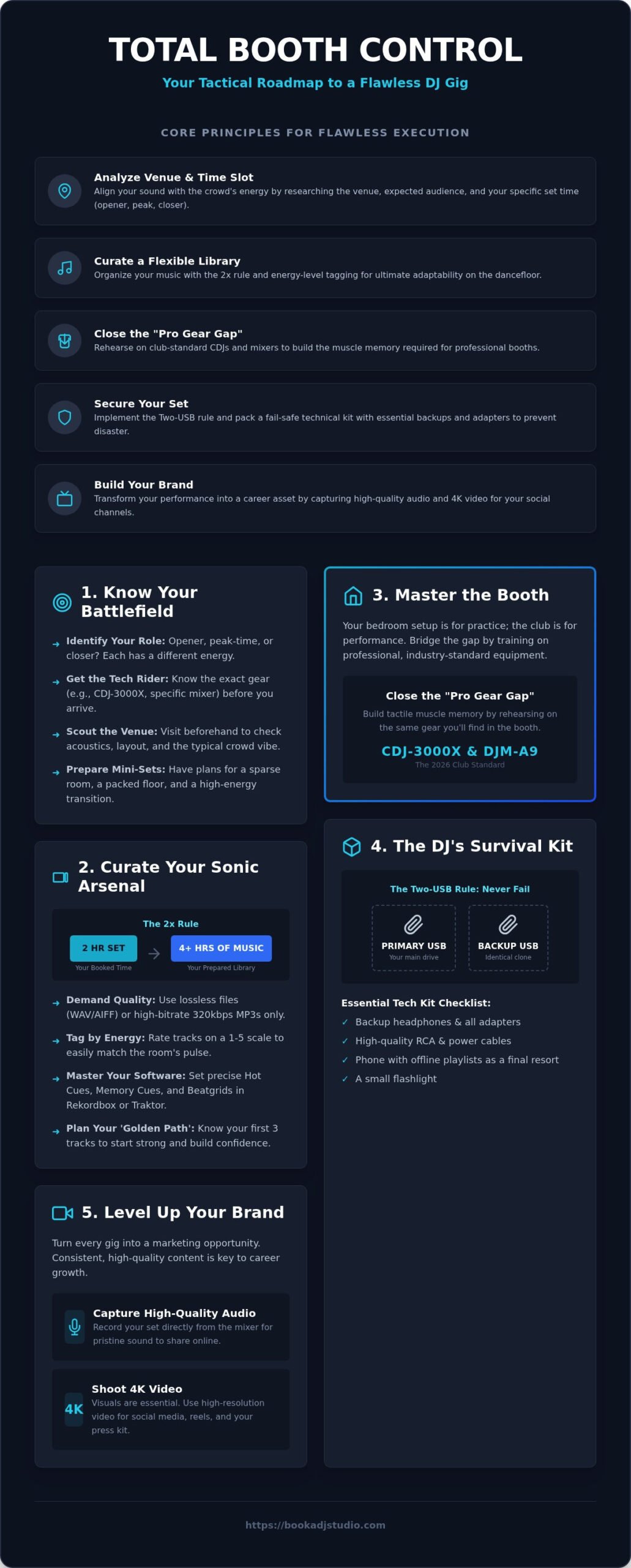
- Analyze your venue and time slot early to align your sound with the crowd’s energy and the night’s flow. 🎯
- Master how to prepare for a DJ gig by organizing your library with the 2x rule and energy-level tagging for ultimate flexibility. 🎶
- Close the “Pro Gear Gap” by rehearsing on club-standard CDJs to build the tactile memory required for professional booths. 🎚️
- Secure your set with the Two-USB rule and a fail-safe technical kit featuring essential backups and adapters. 🔌
- Transform your performance into a brand-building asset by capturing high-quality audio and 4K video for your social channels. 🎥
Know Your Battlefield: Researching the Venue and the Vibe
Intel is your greatest weapon. You wouldn’t drop into a tactical operation without a map, and you shouldn’t step into a booth without a plan. Success depends on your ability to read the environment before you even touch a fader. Knowing how to prepare for a DJ gig starts with deep reconnaissance of the physical and social space you’re about to command. 🎯
Start by identifying your mission. Are you the warm-up, the peak-time hero, or the closer? Each slot demands a specific psychological approach. Mastering essential DJ techniques like phrasing and harmonic mixing is only half the battle; you must apply them to the right energy level. If you’re opening, your job is to build the foundation. If you’re closing, your job is to send them home with a core memory. ⚡
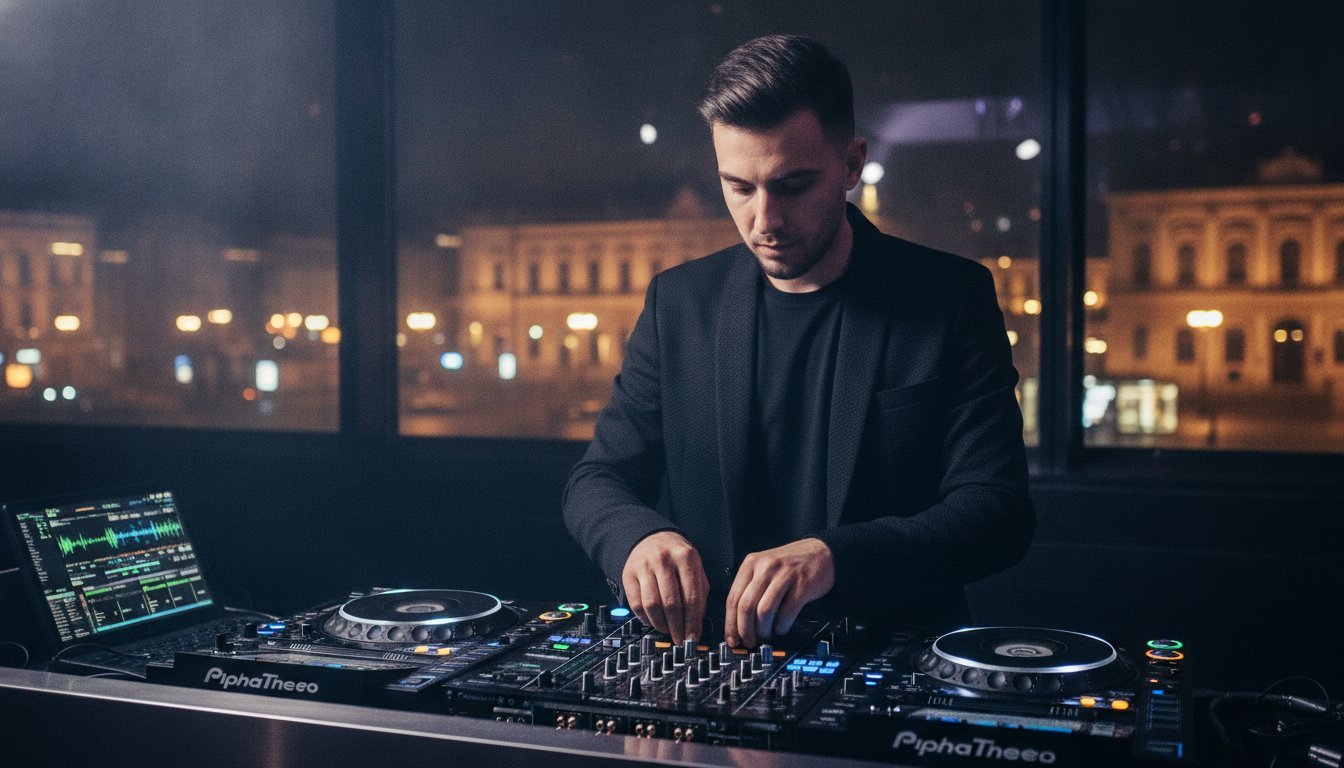
Don’t just trust a text message from the promoter regarding the gear. Ask for the technical rider. You need to know if you’re stepping up to the new AlphaTheta CDJ-3000X units or older hardware. Knowing the mixer layout prevents mid-set panic when you’re searching for a specific FX parameter. If you want to visualize a professional layout, check out our studio gallery to see the club-standard environments we provide for rehearsal.
The Opener’s Creed: Building the Atmosphere
Respect the journey. The biggest mistake a rookie makes is “redlining” the mixer or playing peak-time bangers at 10:00 PM. You’re there to set the mood, not steal the spotlight from the headliner. Research the main act’s recent sets. If they always open with a specific edit, make sure it’s nowhere near your playlist. Aim for tracks that create tension and anticipation. Keep the volume in check and let the room breathe. 🍷
Reading the Room Before You Arrive
Scout the venue a week early. Stand on the dancefloor. Listen to the acoustics. Is the bass muddy in the corners? Is the high-end piercing near the booth? Check the venue’s social media tags to see the typical crowd density and fashion. Identifying the “power players” and regulars in the local scene helps you understand the musical policy. Prepare three different “mini-sets” for different scenarios: one for a sparse room, one for a packed floor, and one for a high-energy transition. Being over-prepared is the only way to stay fearless. 🚀
Curating Your Sonic Arsenal: Music Prep and Organization
Your music library is your most powerful tool. It’s the difference between a legendary set and a forgotten night. When you’re figuring out how to prepare for a DJ gig, organization is your secret weapon. Start with the 2x Rule. If you’re booked for two hours, bring at least four hours of music. This buffer gives you the flexibility to pivot if the crowd isn’t feeling your initial direction. Following DJ community tips on library management ensures you never run out of options. 🎶
Quality is non-negotiable. Stick to lossless formats like AIFF or WAV. If you use MP3s, they must be 320kbps. Professional club sound systems will expose low-bitrate tracks instantly, making your set sound thin and muddy. Beyond genre, organize your tracks by energy level on a scale of 1 to 5. This allows you to match the room’s pulse without scrolling through thousands of files. Always build ’emergency’ crates. These are your ‘break glass in case of fire’ tracks that are guaranteed to save a dying dancefloor. 🆘
Rekordbox Mastery: Setting Your Cues
Precision is everything. Don’t just import tracks; prep them. Set Hot Cues for your favorite mix-in points and Memory Cues to alert you of upcoming phrasing changes. Ensure your beatgrids are 100% accurate. If the grid is off, your sync and effects will be too. Use the ‘My Tag’ feature to categorize tracks by ‘vocal’, ‘dark’, or ‘melodic’. This metadata lets you filter your entire library in seconds during the heat of a set. 🎚️
The ‘Golden Path’ vs. Freestyling
Confidence comes from a solid start. Plan your ‘Golden Path’, which consists of the first three tracks of your set. This settles your nerves and establishes the vibe immediately. Identify ‘mini-mixes’ or sequences of 2-3 tracks that you know work perfectly together. However, leave room for the unknown. Spontaneity is what makes a live performance special. If the crowd reacts to a specific sound, follow that lead. Reading the room is a skill you only sharpen through experience. 🚀
Before you step into the club, you need to hear how these files sound on professional hardware. You can book hourly studio access to test your library and ensure every transition is tight. It’s the best way to gain the confidence you need for the big stage.
Mastering the Booth: Why Studio Practice is Non-Negotiable
Bedroom setups are for learning. The club booth is for performing. One of the biggest shocks for rising artists is the “Pro Gear Gap.” If you have only ever played on a small controller, stepping up to a pair of AlphaTheta CDJ-3000s and a high-end mixer can feel like entering a cockpit without a pilot’s license. Understanding how to prepare for a DJ gig means closing this gap long before the soundcheck. 🎧
Tactile memory is your best friend in a dark, loud environment. You need to know exactly how much resistance a fader has and where the filter knob sits without looking. Stop relying on your laptop screen. In the booth, you should be looking at the crowd and the CDJ displays. Professional institutions like Point Blank Music School emphasize professional DJ training on standard hardware for this exact reason. It builds the instinct you need to survive a high-pressure set. ⚡
Don’t forget the USB test. Real hardware handles files differently than a computer. Testing your drives on club-standard gear ensures your beatgrids are aligned and your playlists load instantly. Before you head to the gig, run this quick hardware check:
- Verify that your USB is formatted to FAT32 or HFS+ for maximum compatibility.
- Check that your Hot Cues and Memory Cues appear correctly on the CDJ screen.
- Test the jog wheel sensitivity and ensure your tracks load in under two seconds.
Rehearsing on Club-Standard Equipment
You must simulate the actual experience. This is why you should book a DJ studio for practice before the big night. Rehearse standing up. Kill the lights. Turn the monitors up. This environment forces you to focus on the sound and the feel of the gear rather than the visual cues of a software waveform. It’s about precision and confidence. 🚀
Recording Your Rehearsal for Review
Listen back to your session with a critical ear. It’s the only way to catch awkward energy dips or messy transitions that you missed in the moment. We offer high-quality audio and 4K video recording so you can analyze every move. Beyond self-correction, these recordings are gold for your social media. A tight 15-minute “mini-mix” recorded in a professional booth proves to promoters that you’re ready for the main stage. 🎥
The DJ’s Survival Kit: Gear and Technical Backups
Your talent is useless if your gear fails. In the high-stakes environment of a club, redundancy is your best friend. Learning how to prepare for a DJ gig means planning for the worst-case scenario before it happens. Start with the Two-USB Rule. Never assume the Pro-Link between CDJs will work perfectly. If one player can’t see the other, you need a second drive ready to go. Carry two identical, synced USBs at all times. 💾
Headphone adapters are the ghosts of the DJ booth; they disappear the moment you look away. Carry three. Keep one on your headphones, one in your bag, and one in your pocket. Protect your most valuable asset: your hearing. Custom-molded earplugs are a professional requirement, not an option. Finally, keep an “Emergency Backup” on your phone or iPad. This should be a pre-recorded 15-minute high-energy mix. If the entire system crashes, you can plug in and keep the vibe alive while you reboot. 🔊
USB Management and Rekordbox Exporting
Speed matters. Use USB 3.0 or 3.1 drives to ensure tracks and waveforms load instantly. For maximum compatibility across all Pioneer DJ and AlphaTheta hardware, format your drives to FAT32. While HFS+ works for Mac users, FAT32 remains the industry standard for universal reliability. Always double-check your “Link” functionality during your studio rehearsal. If your tracks don’t sync across players in the studio, they won’t do it in the club. ⚡
The Physical Pack-List
Don’t rely on the venue for essentials. Pack your own RCA and XLR cables. Carry a basic cleaning kit for your headphones and a microfiber cloth for dusty screens. If you can, bring a spare pair of headphones. A snapped headband in the middle of a set is a nightmare you don’t want to live. Finally, treat every gig as a networking opportunity. Keep business cards or a QR code for your social media ready in your bag. 💼
Ready to test your backup plan? Secure your hourly studio access now and make sure your gear is as ready as you are. Don’t leave your performance to chance.
Level Up Your Brand: Recording and Promoting Your Set
Your gig is more than a performance. It’s the engine for your entire brand. If you treat your set as a one-off night, you’re wasting a massive opportunity to scale your career. Part of learning how to prepare for a DJ gig is designing a content plan that lives long after the lights go down. Every transition and every crowd reaction is a potential viral moment. 🚀
Capture everything. Don’t settle for muffled phone recordings. You need high-quality audio pulled directly from the mixer to ensure your transitions sound professional. Pair this with 4K video to create high-impact Reels and YouTube sets. Promoters want to see how you command a room. High-definition proof of your skill is your most persuasive resume. It’s the evidence that secures your next booking. 🎥
Pre-Gig Content Strategy
Build the hype before you even pack your bags. Share track-teasers of the “secret weapons” you’ve found during your crate digging. Post snippets of your studio sessions to show the work behind the art. Collaboration is key. Tag the venue and the promoters in your countdown posts to tap into their audience. Reach out to the Timișoara DJ community to invite fellow artists to the front left. A supportive crowd of peers elevates the energy and creates better footage for your socials. 🤝
Post-Gig: The Content Long-Tail
The work doesn’t end when the club closes. Upload your professional DJ set recording to Soundcloud or Mixcloud within 48 hours while the energy is still fresh. This keeps the conversation going with those who attended and introduces your sound to those who missed out. 🎧
Break your set down into bite-sized clips. Identify your cleanest transitions or the moment the bass dropped and the room exploded. These are gold for Instagram and TikTok. Finally, use these recordings for self-analysis. Watch your stage presence. Listen to your phrasing. Every recorded set is a lesson that helps you understand how to prepare for a DJ gig even better next time. Professional growth is a cycle of performance and review. Stay hungry. ⚡
Step Into the Booth With Absolute Confidence
Your journey from the bedroom to the main stage is built on the work you do when nobody is watching. Mastering how to prepare for a DJ gig isn’t about luck; it’s about the relentless pursuit of technical perfection and crowd connection. You’ve researched the vibe, locked in your sonic arsenal, and packed your survival kit. Now, it’s time to bridge the gap between preparation and performance. 🚀
Don’t leave your professional reputation to chance. Rehearsing on club-standard equipment ensures your tactile memory is sharp and your transitions are flawless. Our central Timișoara location provides the professional booth you need to eliminate anxiety. Capture every moment with our 4K video recording available to turn your gig into a lifelong asset for your brand. 🎥
Ready to crush your next gig? Book your professional practice session now!
The dancefloor is waiting for someone with your vision. Trust your prep, trust your ears, and own your sound. You’re on the verge of a breakthrough. Let’s make it happen. 🎧⚡
Frequently Asked Questions
How many songs should I have for a 1-hour DJ set?
Pack at least 25 to 35 tracks for a 60-minute slot. This gives you the flexibility to pivot if the energy shifts suddenly. 🎧 You’ll likely play 15 to 22 songs depending on your mixing style, but having double that amount ensures you never run out of heat. Over-preparing is your secret weapon for staying ahead of the crowd and keeping the dancefloor moving.
Should I pre-plan my entire DJ set or freestyle?
Plan your first three tracks to settle your nerves and the last two for a massive finish. Freestyle the middle to read the room’s energy. ⚡️ Locking in a rigid setlist kills the vibe if the dancefloor doesn’t respond to your planned tracks. Knowing how to prepare for a DJ gig means having “mini-routines” of two or three songs that work perfectly together while leaving space for spontaneity.
What should I do if the equipment fails during my gig?
Keep a backup USB and an emergency 3.5mm-to-RCA cable connected to your phone or an iPad. If the link fails or a deck freezes, hit play on your backup source immediately. 🛠️ Don’t panic; stay calm and let the crowd know you’re fixing the issue. Most technical glitches are solved by a quick reboot or switching cables, so always carry spares in your bag for peace of mind.
How do I deal with performance anxiety before a big show?
Channel that nervous energy into focus by arriving at the venue at least 30 minutes before your set. Seeing the room and hearing the sound system builds instant confidence. 🚀 Deep breathing and a solid warm-up routine using Hourly Studio Access can settle your heart rate before you step on stage. Remind yourself that the crowd wants you to succeed and they’re there to share your creative passion.
Is it okay to play songs from a streaming service at a club gig?
Avoid streaming services for professional club gigs because venue Wi-Fi is notoriously unreliable and can drop out. Use high-quality AIFF or 320kbps MP3 files stored on your USB drives instead. 🚫 Dropping a set because of a signal timeout is a rookie mistake that ruins the momentum. Stick to local files to ensure your performance remains seamless, professional, and glitch-free throughout the entire night.
How do I research a venue if I’ve never been there before?
Scope out the venue’s social media videos to see the crowd’s energy and the specific booth layout. If possible, visit the week before to hear the acoustics and check the gear in person. 🔍 Knowing how to prepare for a DJ gig involves understanding the room’s “sweet spots” and what genres the locals respond to. Talk to the resident DJ to get the inside scoop on the sound system.
Why is it important to practice on professional CDJs instead of a controller?
Practicing on club-standard CDJs is vital because the tactile feel and layout differ significantly from home controllers. You don’t want to hunt for the cue button in a dark booth during your set. 🎚️ Booking Session Packages on professional gear ensures your muscle memory is sharp. It builds the technical confidence you need to focus on your creative transitions rather than fumbling with the hardware buttons.
What are the essential items to keep in a DJ gig bag?
Your gig bag needs two mirrored USB drives, high-quality headphones, and professional earplugs to protect your long-term hearing. Include a spare 1/4 inch headphone adapter and a roll of electrical tape for emergencies. 🎒 Throw in a microfiber cloth for dusty screens and a portable charger for your phone. Being prepared for every scenario marks the difference between a hobbyist and a true professional on the verge of a breakthrough.