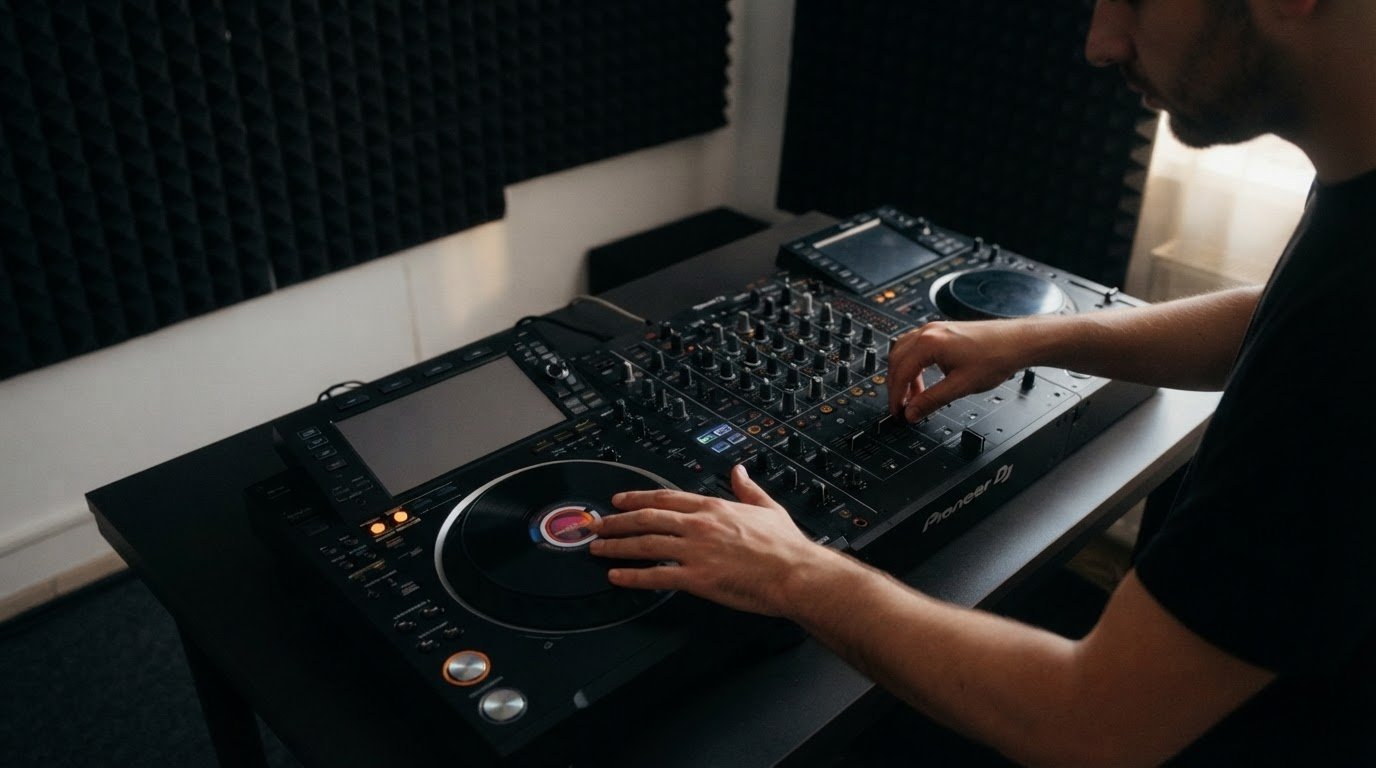

A longer promo mix isn’t automatically a stronger one. If you’re deciding how long a DJ promo mix should be, aim for around 60 minutes to show your range and build an energy arc without asking listeners to commit to a full-length set. For an online audience, a focused 20-minute mix can work well.
You already know every transition has to earn its place. A promo mix isn’t just a stack of tracks; it’s a snapshot of your instincts, selection, and control behind the decks. Keep the music moving, but give standout moments room to land.
Here, you’ll learn how to choose a length for your audience and purpose, shape a focused track journey, and use quick transitions when they sharpen the flow. You’ll also see when to let a blend breathe, how to prepare clean entry and exit points, and how to review a rehearsal so your final recording feels intentional from the first beat to the last.
Key Takeaways
- Match your mix length to its audience and purpose, with a concise online set or a longer showcase when you need to reveal more range.
- Choose a continuous mix or a highlight reel based on whether you want to demonstrate flow or spotlight standout moments.
- Build your track count around the time each selection needs to make its mark, not a fixed target.
- Use quick transitions with intention, and leave room for blends that help the energy breathe.
Recommended promo mix length
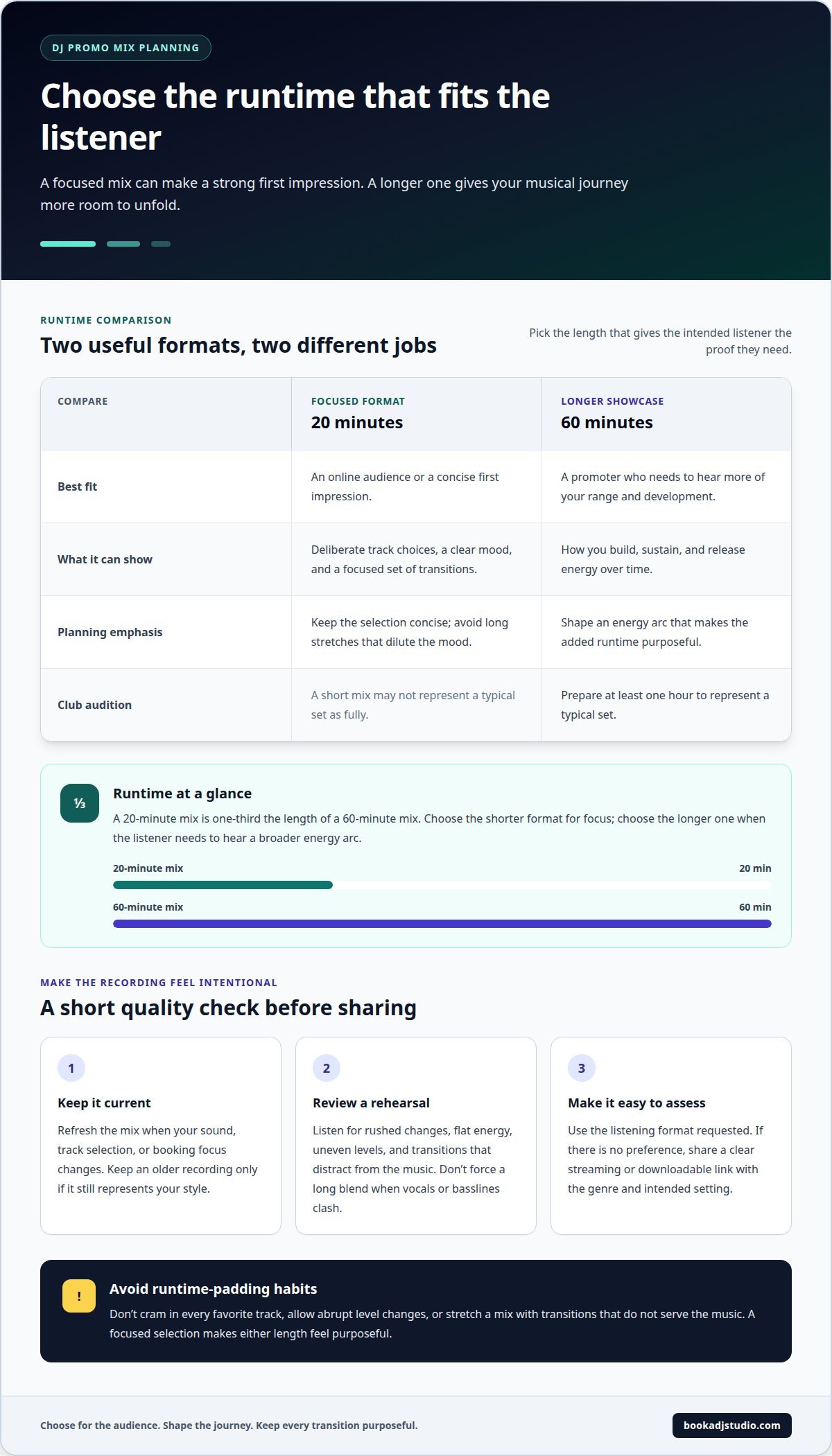
- Choose the runtime for the listener, not your full playlist. A focused 20-minute mix can suit an online audience, while a 60-minute promo gives you room to show range and shape an energy arc. For a club audition, prepare at least one hour to represent a typical set. These are different formats, not competing rules for how long a DJ promo mix should be.
- Match the mix to its purpose. Use 20 minutes to make a concise first impression, with deliberate track choices and no long stretches that dilute the mood. Choose 60 minutes when a promoter needs to hear how you build, sustain, and release energy over time. For a club audition, an hour-long set can demonstrate that your selection holds together beyond a short highlight.
- Update your promo mix when your sound, track selection, or booking focus changes. If your current mix no longer represents the sets you want to play, prepare a fresh version. Keep the previous recording only if it still reflects your style and gives listeners a useful picture of your work.
- Share the mix through the platform or listening format a promoter requests. If they give no preference, send a clear streaming or downloadable link with a concise note identifying the mix’s genre and intended setting. Keep the link easy to open, and use a filename that identifies you and the recording.
- Avoid packing the mix with every favorite track, abrupt level changes, or transitions that distract from the music. For example, don’t force a long blend when vocals or basslines clash. Record a rehearsal, then listen for rushed changes, flat energy, and uneven levels. A focused selection and clean sound make the runtime feel purposeful, whether you choose 20 minutes or an hour.
Should a DJ promo mix be one continuous mix or a short highlight reel?
- Choose the format for the proof you need to deliver. A continuous mix shows how you manage flow across several tracks, from the opening selection through the final transition. A highlight reel puts standout moments up front, such as a sharp genre switch or a tightly timed drop. Let the booking context decide which skill matters most.
- Build a continuous mix around a clear musical journey. Set an opening mood, develop the energy, and give the ending a deliberate resolution. For example, connect three compatible tracks through longer blends, then change direction at a phrase boundary. This format lets a listener hear your pacing and track selection working together, not just isolated tricks.
- Cut a highlight reel only when each excerpt makes a distinct point. Select moments that demonstrate different strengths, such as clean phrasing, a confident cut, or control between contrasting arrangements. Avoid stacking similar drops. If two excerpts show the same technique, keep the stronger one and use the space to reveal another side of your sound.
- Rehearse both versions before choosing what to share. Record a longer blend and a short alternative, then listen for what each communicates. Does the continuous take hold its direction? Does the reel feel coherent rather than random? Compare the openings, transitions, and endings. Keep the format that best represents the set you want to play.
- Keep the edit honest and easy to follow. Don’t disguise a rough transition by cutting away at the exact moment it happens. A highlight reel can be edited, but each excerpt should still represent your actual mixing. For a continuous recording, check that levels remain consistent and that the final track doesn’t stop abruptly. Make every choice support the performance.
A sixty-minute DJ promo mix can be a useful middle ground: it is long enough to show range and let the energy ebb and flow, while remaining short enough for a listener to finish. That makes a continuous format easier to assess as a complete journey, without asking for an extended commitment. Keep the sequence purposeful so the added runtime reveals contrast and development rather than simply stretching the set.
If the booking is for a short performance slot, a concise highlight reel may be more relevant, particularly when there is room for a practiced DJ routine. Let the excerpts give a quick sense of that routine, then choose the continuous mix when the listener needs to hear how you sustain a broader arc.
How many tracks should a DJ promo mix include?
- Let the runtime and transition style determine the count. There’s no fixed number of tracks that suits every promo mix. A long blend lets each selection establish its mood, so you’ll use fewer tracks. Quick cuts move through selections faster. Plan the musical journey first, then choose enough tracks to support it without cramming in every favorite.
- Decide what each track contributes. Give every selection a role, such as opening the mix, lifting the energy, changing the texture, or creating a landing point. For example, if two tracks deliver the same mood and function, keep the one with the stronger transition into your next choice. A leaner sequence can feel more intentional.
- Map transitions before finalizing your playlist. Mark the incoming track’s start phrase and the outgoing track’s exit phrase. Then check whether vocals, basslines, chords, and phrase lengths leave space for the overlap. If the arrangement gets crowded, shorten the blend or cut at a phrase boundary. That decision can change how long each track stays in the mix.
- Prepare alternatives for key moments. Build more than one route into a shift in energy or style. For instance, keep an alternative track ready if the first choice clashes harmonically or brings competing vocals. You don’t need to play every option. A flexible playlist helps you preserve the mix’s direction while avoiding a forced transition.
- Review the count by listening, not by chasing a target. Record a rehearsal and notice where the sequence feels rushed, static, or balanced. If a track contributes little before the next transition, tighten its place in the mix. If a key moment needs more room, let the musical phrase develop. Keep the final count that makes the selection and flow feel purposeful.
What are the best practices for structuring a DJ promo mix?
- Shape the sequence for a specific crowd. Choose tracks that fit the venue, genre, and energy you want to demonstrate. A focused mix for a club’s late-night crowd can communicate more than a longer run of personal favorites. Give each selection a clear role: opening, lift, contrast, or release.
- Plan an arc, not a straight climb. Start with a track that establishes the sound, then create movement through contrast and momentum. For a warm-up or long bar set, leave more space between changes. An energy rating helps compare tracks, but it can’t predict how an audience will respond.
- Use quick transitions to solve a musical problem. A short change can avoid overlapping busy vocals, bridge contrasting arrangements, or introduce a recognizable phrase. Mark the incoming track’s start and the outgoing track’s exit before recording. Keep a longer blend when rhythms align and both tracks leave room for their musical parts.
- Vary your transitions instead of repeating one trick. A fast cut can add impact, but repeating the same effect throughout the set makes it predictable. Use a cut for a sharp change in texture, then let another transition breathe. Here, “fast” and “slow” describe how quickly tracks change, not their BPM.
- Rehearse, record, and refine the structure. Listen for rushed sections, static energy, and moments where the next track arrives too early. If a blend feels crowded, try a percussion-only overlap, shorten it, or cut at a phrase boundary. Record your next promo mix once each transition supports the direction of your set.
Keep the purpose of the recording visible as you make final choices: the mix should represent a particular crowd, rather than simply collect tracks you enjoy. A focused DJ promo mix made for a specific crowd can be more effective for getting gigs than a longer mix of your favorite songs, even if that longer mix runs two hours. Let that aim guide which moments deserve space and which should move on.
Treat standout techniques as accents. A technique that draws attention once can become tiring when repeated throughout a DJ set, so use it selectively and let the surrounding transitions provide variety.
Book a DJ Studio
Book a DJ Studio gives you a professional space to shape and capture your promo mix. Use Hourly Studio Access or Session Packages to prepare and record a focused set, then choose Audio Recording or 4K Video Recording to capture the performance. It’s a practical next step when your track selection and transitions are ready, but you need a dedicated studio session to bring the mix together.
Bring your planned track order, cue points, and transition notes. Use the session to perform the mix as one complete take, listen back, and refine the details that affect its flow. If you’re ready to record, contact Book a DJ Studio to discuss your session.
Prepare Your Next Promo Mix
Before recording, decide what the mix should demonstrate, such as your track selection, transitions, and pacing. Choose tracks and arrange them to support that goal. The question of how long a DJ promo mix should be matters less when each section has a clear purpose and the full recording presents your work consistently.
Before you press play, check your equipment and recording levels. Listen through the finished file for clipping, gaps, or abrupt changes, and make any needed edits. A careful review helps ensure the mix is clear from start to finish.
If you’re ready to record your next set, contact Book a DJ Studio. Bring your selected tracks and planned running order, then record your mix behind the decks.
Frequently Asked Questions
How long should a DJ promo mix be when applying to a radio show or festival?
Use the runtime in the submission instructions. If none is given, choose a length that clearly presents your proposed sound.