
A strong DJ set doesn’t keep climbing; it moves with intention. Energy level management in a DJ set means balancing calmer tracks, rising intensity and well-timed drops, so the crowd has room to feel each shift. Tempo matters, but mood, rhythm and track density shape the energy too.
You know a run of bangers can lift the room. The craft lies in knowing when to ease back, build again or change direction without losing the connection. Shape the flow, and each peak can hit harder.
Try four practical ways to guide that journey: use calmer tracks to set up a powerful sequence, create contrast between peaks and breathers, read the crowd’s response, and learn from the history of energy flow in DJ sets. Together, they offer a clear framework for making track selection feel like a story, not just a string of big moments.
Key Takeaways
- Set up a high-impact track with calmer selections, and judge energy by mood and intensity, not BPM alone.
- Alternate peaks with lower-intensity moments to give the crowd room to breathe and make the next lift land.
- Watch how different parts of the crowd respond, then adjust your next transition to match the room.
- Use the storytelling approach behind DJ set history to shape a clear journey from warm-up to peak and release.
1. Using calmer tracks before a powerful sequence
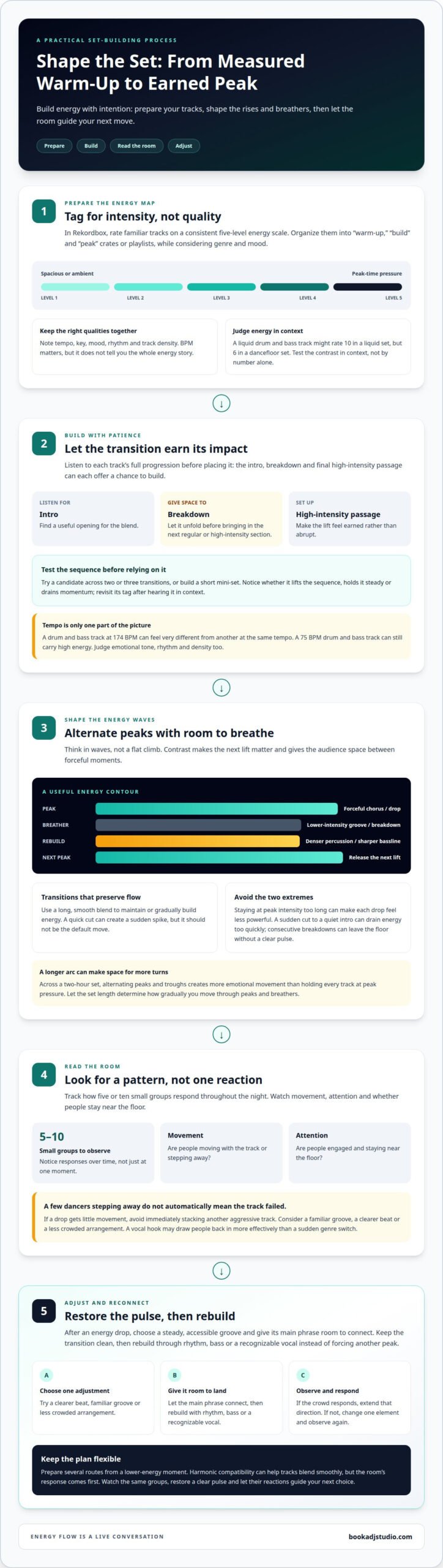
For a warm-up, keep the intensity measured and leave room for the next DJ. At peak time, shape a clear route toward your strongest tracks. A closing set can ease the tension and guide the room toward a satisfying landing. Listen to each track’s full progression before placing it: its intro, breakdown and final high-intensity passage may each offer a chance to build. If a breakdown is unfolding, let it play before bringing in the next track’s regular or high-intensity section. That patience can make the transition feel earned rather than abrupt.
In Rekordbox, tag familiar tracks using a consistent five-level energy scale, from spacious or ambient to peak-time pressure. Rate energy, not musical quality. Sort tracks into crates or playlists such as “warm-up,” “build” and “peak,” while considering genre and mood. Test a candidate across two or three transitions, or make a short mini-set. Notice whether its intensity lifts the sequence, holds it steady or drains momentum. Revisit the tag after hearing the track in context.
BPM, musical key, and intensity each shape energy, but tempo alone won’t tell you how forceful a track feels. A drum and bass track at 174 BPM can feel very different from another at the same tempo; a 75 BPM drum and bass track can still carry high energy. Use compatible keys and phrase timing to support a smooth blend, then judge the emotional tone, rhythm, and density. In Rekordbox, keep those qualities alongside tempo in your track notes.
Build tension by adding layers or increasing rhythmic complexity, then use EQ, reverb, or delay to create anticipation before release. Let set length determine how gradually you move through peaks and breathers; a longer arc can make space for more turns. Genre shifts your energy scale too: a liquid drum and bass track might rate 10 in a liquid set, but 6 in a dancefloor set. Test the contrast in context, not by number alone.
2. Alternating energy levels to create contrast
Think in waves, not a flat climb. A wave structure alternates peaks and troughs, keeping a long set engaging while giving the audience room to breathe. After a forceful chorus, shift into a lower-intensity groove, then rebuild with denser percussion or a sharper bassline. Across a two-hour set, this changing contour creates more emotional movement than holding every track at peak pressure.
Contrast helps prevent listener fatigue. A relentless run of high-energy tracks can make each new drop feel less powerful, even when the mixing is clean. Instead, create a deliberate reset: move from a driving section into a breakdown, then let the next track restore momentum. Make the transition intentional. Cutting straight from high intensity to a quiet intro can drain energy too quickly, while blending one breakdown directly into another may leave the dancefloor without a clear pulse.
Common mistakes include staying at peak intensity too long, dropping energy without a plan and treating every transition as a chance to make the biggest impact. Listen to the sequence as a whole: does the lower-energy track create contrast, or interrupt the groove? Try a long, smooth blend to maintain or gradually build energy. Use a quick cut for a sudden spike, not as your default move.
Surprise works best when the audience can feel the shift, even if it didn’t expect it. For example, follow a familiar high-energy hook with a rhythmically distinct track that keeps the beat moving while changing the mood. Then use a clean transition to reveal the next peak. Rehearse that energy turn in a focused DJ practice session, and listen for whether the contrast creates anticipation or breaks the flow.
Tempo alone doesn’t determine energy: dynamics and tension-building techniques can make a slower-tempo set feel high-energy. A well-timed drop can create contrast, give the audience a breather and prepare the next build. This can help a set hold the dancefloor for two hours. Without lower-intensity variation, a relentless run of high-energy tracks can lose impact through listener fatigue. A cut to a breakdown can provide a rapid cool-down.
3. How professional DJs read the crowd to maintain energy?
Read the dancefloor as it changes, rather than judging it by a single reaction. Track how five or ten small groups respond throughout the night: watch their movement, attention and whether they stay near the floor. A few dancers stepping away don’t automatically mean the track failed. Look for a wider pattern before changing direction. Effective energy level management in a DJ set starts with noticing these patterns, not guessing from one reaction.
Notice when the response shifts. If a drop gets little movement, avoid immediately stacking another aggressive track. Consider the context: the room may need a familiar groove, a clearer beat or a less crowded arrangement. Listen to how the current transition lands, too. A vocal hook that draws people back in may work better than a sudden genre switch. Read body language alongside the sound, then make one deliberate adjustment.
To recover the dancefloor after an energy drop, choose a track with a steady, accessible groove and give its main phrase room to connect. Keep the transition clean, then rebuild through rhythm, bass or a recognizable vocal instead of forcing another peak. If the crowd responds, extend that direction; if not, change one element and observe again.
Keep your set plan flexible. Prepare several routes from a lower-energy moment, such as a familiar track leading into a deeper groove or a more driving rhythm. Harmonic compatibility can help the tracks blend smoothly, but the room’s response comes first. Treat energy level management in a DJ set as a live conversation: watch the same groups, restore a clear pulse and let their reactions guide your next choice.
4. Energy-flow history in DJ sets
Energy flow became a storytelling tool through extended DJ sets. In the 1970s and 80s, Larry Levan and Frankie Knuckles helped establish sets shaped by pacing, build-ups, and breakdowns. Instead of treating each track as a separate peak, they could use a gradual sequence to create anticipation and release. The takeaway for your own set: make each section serve the larger journey, not just the next transition.
During the 1990s, house and techno grew, and DJs including Carl Cox and Sasha became known for manipulating energy. That approach makes room for more than one high point. A Story structure can build through smaller climaxes, reach a main peak, then cool down. Across an opening, middle, and closing section, give each phase a clear role instead of pushing maximum intensity from the first track.
The rise of EDM in the 2000s and 2010s brought a more formulaic approach, with predictable drops and peaks. Those moments can still work, but repeating the same build-and-drop pattern may make a set feel easy to anticipate. Add contrast by varying the length of a build, holding a breakdown, or letting a groove develop before the next payoff. Dance music often uses 32-beat phrases, so phrase awareness can help you place changes with intention.
Map your set as Warm-up, Build-up, Plateau, and Peak, then decide where the closing should release tension. Use playlist notes or DJ software to mark each section’s purpose, such as “introduce groove” or “hold energy.” In rehearsal, listen for whether one phase earns the next. Rehearse your set’s energy arc and shape a journey that feels deliberate, not formulaic.
A typical DJ set can be organised into Warm-up, Build-up, Plateau and Peak phases. Treat these labels as planning choices: decide what the listener should experience in each phase, then choose transitions that support that purpose. They need not dictate a fixed intensity; they help you check whether your sequence has room to develop.
Before playing, write a brief intention beside each phase and compare it with the energy of your selections. If two adjacent phases seem to do the same job, revise the order or clarify what you want the transition to change. This keeps the arc clear while leaving room to respond in the moment.
Book a DJ Studio
Book a DJ Studio gives you a focused space to rehearse how your set builds, shifts, and resolves. Use Hourly Studio Access or Session Packages to practise transitions and refine the energy arc without the pressure of a live crowd. Audio Recording and 4K Video Recording let you revisit your performance, spot moments where momentum dips, and hear whether each build earns its peak. That playback can help you make more intentional choices before your next set.
If you’re ready to shape your next mix in a dedicated studio, contact Book a DJ Studio.
Make Your Next Set More Intentional
Your next breakthrough can start with one focused rehearsal. Instead of rebuilding your entire playlist, choose an uncertain section and experiment with a different route through it. Keep the version that feels purposeful, and let go of transitions that distract from the musical story you want to tell.
Energy level management in a DJ set becomes more instinctive through practice. Make room to test ideas, listen back and shape a sound that feels distinctly yours. Each session can bring you closer to a confident set that leaves a lasting impression.
Ready to give your next mix dedicated space to develop? Contact Book a DJ Studio and take your next creative step with confidence.
Frequently Asked Questions
What is the importance of energy flow in a DJ set?
It gives your track choices a clear direction, helping the audience connect with the set as one musical journey rather than a series of isolated moments.
How do professional DJs read the crowd to maintain energy?
Watch movement, attention and reactions to specific sounds. Singing along or responding to a vocal can reveal what’s connecting beyond dancefloor activity alone.
How do DJs read the crowd and adjust energy in real time?
Notice a change in response, adjust one musical element, then observe what happens next. This makes it easier to choose a useful direction.
How can DJs plan an energy arc while leaving room for improvisation?
Choose a few anchor tracks and prepare alternate routes between them. This gives the set direction while leaving transitions open to the room’s response.