

Your demo mix doesn’t need to prove you own the biggest collection. It needs to make someone hear your point of view. When you’re deciding what tracks to include in a demo mix, it’s easy to get stuck between familiar crowd-pleasers, fresh discoveries, and every favourite you want to squeeze in.
Choose tracks for the journey they create, not only for how much you like them on their own. A focused musical direction, purposeful changes in energy, and a few defining selections will make a stronger impression than a crowded tracklist. This guide walks you through choosing tracks, planning the arc, testing transitions, and preparing your final selection for a demo recording.
Key Takeaways
- Decide what tracks to include in a demo mix by giving each selection a clear role in expressing your musical identity.
- Shape your tracklist through four stages: establish, develop, create contrast, and resolve.
- Build variety through changes in mood, intensity, texture, or carefully chosen genre shifts, not just more genres.
- Listen through your planned sequence and check its direction, pacing, transitions, variety, and ending before recording.
- For a session at Book a DJ Studio in Timișoara, scan tracks in Rekordbox before exporting them to a USB stick no larger than 32 GB.
What Should a DJ Demo Mix Prove Through Its Track Selection?
A DJ demo mix is a short, intentional performance that lets someone hear your musical identity in action. It’s not a folder of favourites or a race to show how many genres you know. Your track choices, sequence, and transitions should give the listener a clear sense of your taste and how you guide a set.
As you decide what tracks to include in a demo mix, give every candidate a job. Does it establish the direction, lift or ease the energy, create purposeful contrast, or make a transition feel natural? If it does none of those things, it may be a great track for another set, but it probably doesn’t belong in this one.
Listen for how a DJ mix uses track selection and transitions to shape a continuous listening experience. For a demo, that flow also needs to reveal your point of view.
To hear a discussion of what can make a demo mix feel more polished, watch this video from iZotope:
Start with the listener and the purpose of the demo
Picture who may hear the mix and what you want them to remember. A personal showcase can capture the sound you’re exploring now. A demo for a specific opportunity should make its fit clear, whether that means a particular mood, setting, or style of set. You don’t need to predict every listener’s taste. Choose one primary direction, then select tracks that make it easy to recognise.
Before building the tracklist, complete this sentence: “This demo is a [sound or mood] set for [listener or opportunity], designed to leave them feeling [impression].” Keep it specific enough to guide your choices, but flexible enough to let the mix breathe. If a track pulls the set away from that purpose, save it for another mix.
Choose a sound you can own
Start with music you genuinely enjoy playing. Your confidence behind the decks comes through in phrasing, timing, and the way you connect one record to the next. Familiar influences can help listeners understand your musical roots, but they are context, not a blueprint. Don’t build a set just to sound like a DJ you admire.
Range can make a demo more revealing when the changes still feel like they come from the same taste. You might move between intensities or textures while keeping a shared mood or groove. Test each addition with one question: Does this track strengthen the story the mix tells? If yes, work on the transition. If not, trust your edit. A focused selection says more than a crowded one.
How to Build a Demo Mix Tracklist From Opening to Closing
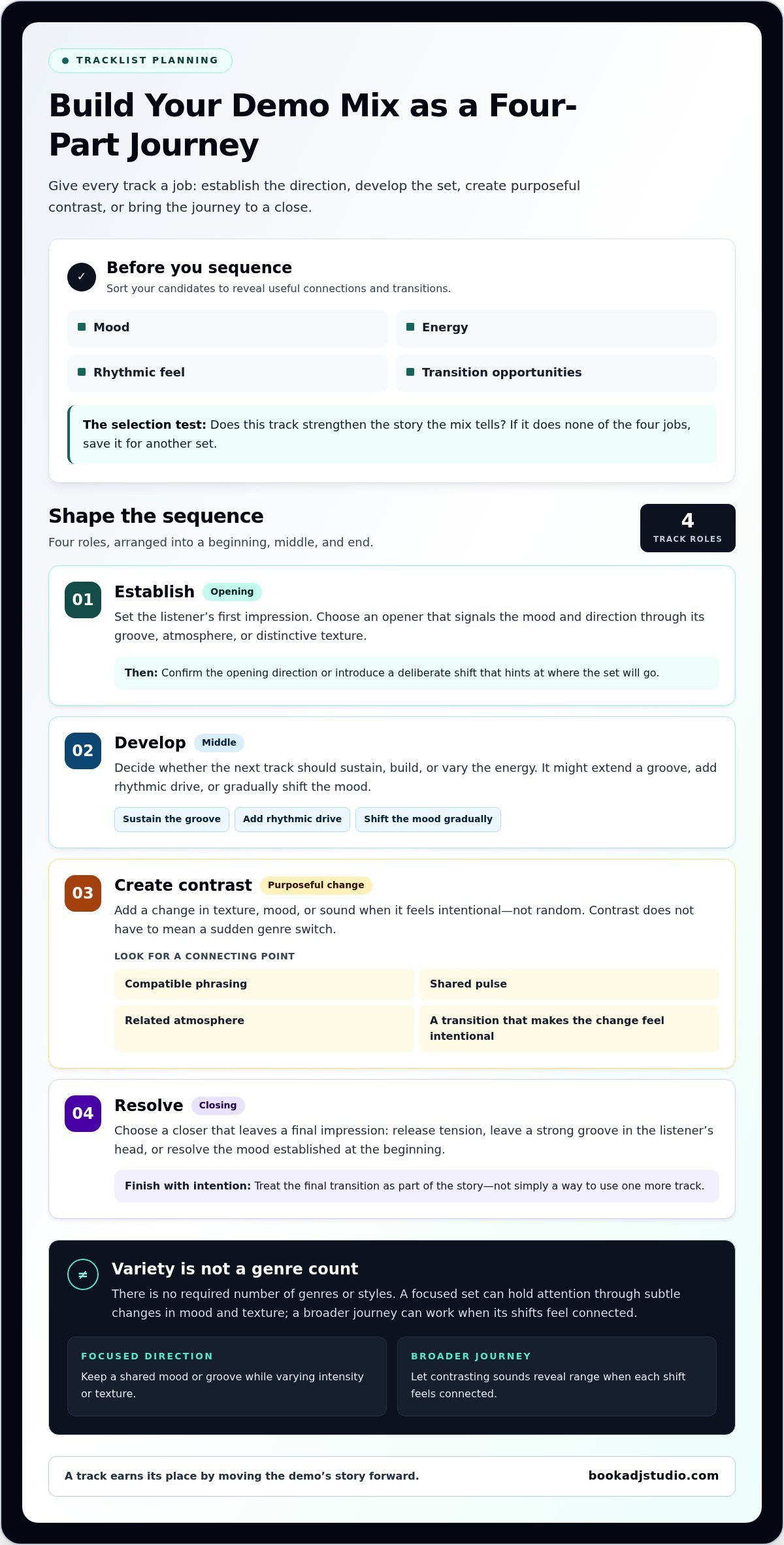
Once you have a clear musical direction, turn your shortlist into a sequence with a beginning, middle, and end. Give each track one of four roles: establish, develop, create contrast, or resolve. These are functions, not genre rules. Your set doesn’t need to climb in energy from start to finish, and contrast doesn’t have to mean a sudden genre switch.
A track earns its place by moving the demo’s story forward, whether it sets the tone, deepens the momentum, adds purposeful contrast, or brings the journey to a satisfying close.
Before ordering the tracks, group your candidates by mood, energy, rhythmic feel, or transition opportunities. Notice which records share a groove, which introduce a useful change in texture, and which could bridge two different sounds. This gives you options for shaping the sequence without forcing every favourite into the mix.
Give the opening tracks a clear job
Your opener is the listener’s first glimpse of the set’s world. Choose a track that signals the mood and direction quickly through its groove, atmosphere, or distinctive texture. It doesn’t have to be the loudest or most dramatic tune. A track with room for a clean blend can show your mixing style while letting your musical identity come through.
Give the next selection a purpose, too. It can confirm the opening direction with a related rhythm or mood, or introduce a deliberate shift that hints at where the set will go. If you open with a spacious, restrained track, for example, the next record might bring in a firmer groove without abruptly changing the set’s character. Avoid choosing an opener only because it has the biggest drop. A peak moment lands better once the listener understands the journey.
Develop the middle and plan a satisfying close
In the middle, decide whether each transition should sustain, build, or vary the energy. A development track can extend a groove, add rhythmic drive, or gradually shift the mood. For contrast, look for a connecting point, such as compatible phrasing, a shared pulse, a related atmosphere, or a transition that makes the change feel intentional. The aim isn’t to make every track sound alike. It’s to make each turn feel like your choice.
Choose a closer that leaves a final impression. It could release tension, leave a strong groove in the listener’s head, or resolve the mood you established at the beginning. Listen to the final transition as part of the story, not simply as a way to use one more track. A clear ending feels intentional; a mix that runs out of songs feels unfinished.
For a practical planning pass, list your candidates under the four roles, then imagine the transition between each pair. As you decide what tracks to include in a demo mix, keep the sequence flexible until the handoffs make musical sense. You can refine that arc through practice in a ready-to-use DJ studio in Timișoara, then bring your strongest version into a recording session.
How Much Variety Belongs in a Cohesive DJ Demo Mix?
There’s no required number of genres or styles for a strong demo. The right amount of variety adds dimension while keeping your musical point of view easy to hear. A focused set can hold attention through subtle changes in mood and texture; a broader journey can work, too, when its shifts feel connected rather than random.
| Single-lane selection | Broader journey |
|---|---|
| Builds a concentrated mood or groove, making the set feel direct and tightly focused. | Moves through more contrasting sounds, revealing range when each shift has a clear purpose. |
| Can feel one-note if tracks repeat the same energy and texture without development. | Can feel like a playlist if transitions don’t give the listener a reason to follow each change. |
| Works when small changes in rhythm, arrangement, or intensity keep the sound alive. | Works when a shared thread, such as groove or atmosphere, connects different styles. |
Variety doesn’t have to mean a dramatic genre switch. Change the intensity, introduce a different rhythmic feel, or move from a dense track to one with more space. A shift from straight four-on-the-floor into a syncopated rhythm, for example, can feel natural if the bass weight, tempo feel, or mood gives the listener a bridge. Keep a contrast when it creates a memorable turn. Cut it when it interrupts the demo’s identity without adding a useful moment.
Show range without turning the demo into a playlist
Find the thread that links your choices. It might be a warm, late-night atmosphere, weighty low end, playful percussion, or a particular sense of swing. Then use contrast selectively. If every favourite appears just because you love it, the mix can lose direction and make your strongest choices harder to remember. Let each shift reveal another side of the same taste.
Balance recognisable tracks with personal discoveries
A familiar track can give the listener an immediate point of connection, but include it only if it fits the set and you can play it with conviction. Less familiar selections can make your taste distinct. Pair a discovery with a clear musical cue, such as a related groove or mood, so the choice feels inviting rather than disconnected. There’s no magic ratio; judge each track by what it contributes to the sequence.
To decide what tracks to include in a demo mix, describe the set’s thread in a few words, then scan the tracklist. Mark each track that strengthens that quality, adds purposeful contrast, or creates a satisfying transition. If a selection does none of those things, save it for another mix. Your demo doesn’t need to show every corner of your collection. It needs to make your range sound intentional and unmistakably yours.
How to Test and Refine Your Demo Mix Tracklist
A tracklist can look convincing on screen and still feel awkward once you mix it. Test the planned sequence from start to finish, and take notes as you listen. Pay attention to the journey, not only whether each track is a favourite.
Use this checklist to spot where the selection needs work:
- Direction: Can you describe the mix’s musical identity after listening?
- Pacing: Does the energy hold, build, or ease off with intention?
- Transitions: Does each handoff connect the tracks musically?
- Variety: Do changes add interest while keeping the set recognisable?
- Ending: Does the final track leave a clear impression?
Mark any point where the flow feels disconnected. Then identify why: perhaps the mood changes too sharply, the incoming rhythm doesn’t sit comfortably, or a track repeats an idea the mix has already delivered. Try changing the order or replacing that selection. Don’t add more tracks just to cover a weak transition. A tighter edit often makes the set stronger.
Listen for flow, not just individual favourites
Give each transition a close listen. Ask whether the outgoing and incoming tracks support the mood you want, and whether a change in energy feels deliberate or accidental. A sudden jump can be exciting when it creates contrast, but distracting when nothing prepares the listener for it.
After your own review, ask a trusted listener what musical identity they heard. Keep the question open. If their description is far from the direction you intended, revisit the choices and transitions that may be obscuring your point of view. For a recorded final run-through, the guide to professional DJ set recording can help you prepare and listen back with fresh ears.
Prepare the selected tracks for a recording session
Once the sequence feels focused, prepare your music before you arrive. Scan the tracks in Rekordbox, then export them to a USB stick no larger than 32 GB. You can also bring your music on an HDD. At Book A DJ Studio in Timișoara, a wired recorder is provided for recording DJ sets, so your prepared tracklist can move from practice to a recorded run-through. Bring your headphones, too.
Make one final pass with the set’s story in mind. Keep transitions that carry it, adjust moments that pull you out of it, and remove any track without a clear role. A focused rehearsal in a recording environment can help you find the performance you want to capture.
Turn Your Final Tracklist Into a Record-Ready Demo in Timișoara
Your sequence is ready. Define the sound you want listeners to remember, rehearse the transitions, and prepare to perform the set from start to finish. A focused run-through helps you stay present behind the decks instead of second-guessing your selections.
Book A DJ Studio offers a ready-to-use space in Timișoara for practising and recording DJ sets, with two Pioneer CDJ-3000X players and a Pioneer DJM-V10 mixer. The booth also has a Yamaha DXS15 MKII subwoofer and two Yamaha DXR12 MKII speakers. For recorded content, the studio’s setup includes 4K video from three angles.
Know what to prepare before you arrive
Bring your prepared music on a USB stick no larger than 32 GB or on an HDD, along with your headphones. Scan your tracks in Rekordbox before exporting them to the USB stick. The studio equipment is powered on and ready to use, and a wired recorder is provided for recording. Recorded mixes are uploaded and emailed to the address on your booking schedule a few days after recording, giving you time to listen back and decide on any final refinements.
Make a practice session part of your next step
Play the complete sequence in the booth and focus on performing it as you intend to record it. If your demo supports a broader career plan, the DJ career guide for Romania offers related ideas to consider.
When your tracklist is ready, book a DJ studio session through the online form and bring your sound to life.
Let Your Next Set Make the Statement
Your demo doesn’t need to sound like anyone else’s idea of a perfect set. It needs to sound like a choice you stand behind. Once you’ve settled what tracks to include in a demo mix, give the recording a little space, then listen again with one question in mind: would the right listener recognise your musical point of view?
That final perspective can help you distinguish a set that simply plays well from one that leaves a lasting impression. Trust the selections that feel honest, make deliberate decisions behind the decks, and let your mix open the door to the next opportunity.
Ready to bring your set into the booth and record it? Book a DJ studio session in Timișoara through the online form and give your sound room to come through.
Frequently Asked Questions
How many tracks should I include in a DJ demo mix?
There’s no universal track count. Choose enough music to deliver the mix’s purpose without padding it. When deciding what tracks to include in a demo mix, consider how much time you have to make an impression, then focus on selections that each contribute something distinct. Try removing one track and listening again. If the set still feels complete, that selection may not have earned its place.
Should a demo mix include different genres?
Yes, if the change feels like a choice rather than a detour. A shift from house into a breakbeat track, for example, might work if a shared pulse or atmosphere connects them. Before keeping a genre change, identify what it adds: a fresh groove, a mood change, or a moment of surprise. If you can’t name its purpose, it may distract from the demo’s direction.
Should I use popular tracks in my DJ demo?
You can include a popular track if it fits the set and gives you room to show your own selection and mixing decisions. A recognisable record may help a listener settle into the sound, but familiarity alone doesn’t make it the right pick. Ask whether you’d still choose it if nobody recognised it. If the answer is yes, it likely belongs for musical reasons, not just name recognition.
How do I make a demo mix tracklist flow?
Listen to the tracklist in sequence, paying attention to how one record prepares the listener for the next. Check practical details as well as mood: compatible phrasing, an outro that gives you room to blend, or a rhythmic element that carries across the transition. If a handoff feels abrupt, decide whether that jolt is intentional. If not, test a different order or selection.
Can I include unreleased tracks in a DJ demo mix?
You can consider an unreleased track if it suits the set and you have permission to use it where required. Don’t rely on exclusivity to carry the demo. Test whether the track works alongside the surrounding selections and adds a quality listeners can hear, such as a distinctive groove or mood. Keep private or unreleased material within the permissions you’ve been given.
What should I do if my demo tracklist feels too predictable?
Ask someone who hasn’t seen your tracklist to listen and describe what stood out. Their response can reveal whether the set feels familiar because of repeated sounds, a steady energy pattern, or transitions that all resolve the same way. Then experiment with one change at a time, such as adding a different rhythmic texture. Listen again before making another edit, so you can hear what actually changed.
Should I plan every track before recording a demo?
Plan the core sequence, but leave yourself a little room to respond in the moment. Mark the records that anchor the set and rehearse the transitions that need precision. You can also prepare a small group of compatible alternatives in case a spontaneous choice feels stronger during the performance. That balance keeps you prepared without making the mix feel like you’re following a rigid script.