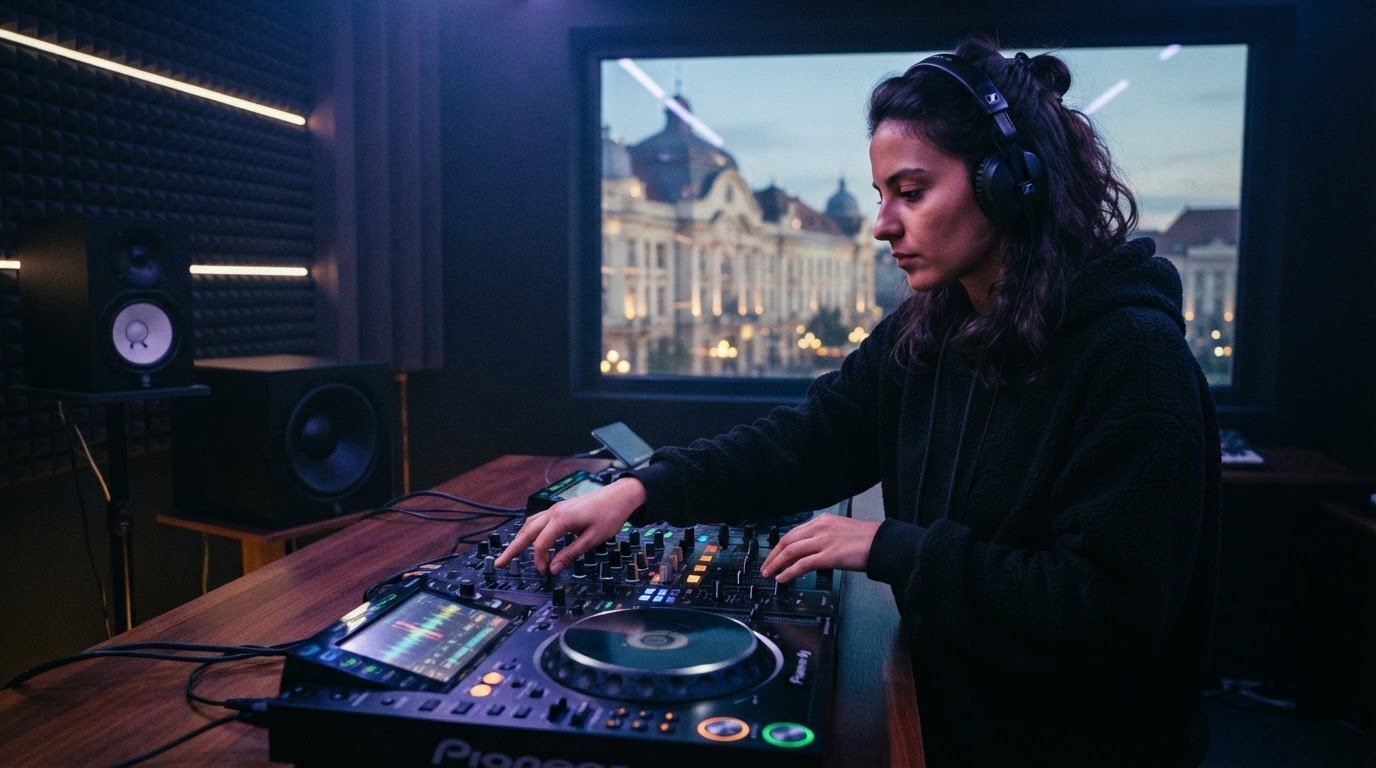

Confidence for your next club set starts with focused practice, not a last-minute scramble. Moving from a controller to CDJ players can feel unfamiliar, but purposeful repetition helps make the workflow second nature.
Learn how to practise cueing, beat-matching and transitions, then bring those skills together in a full set. Book a DJ Studio in Timișoara gives you a space to practice on cdj 3000 players and prepare for your next performance. Bring your music ready, choose a skill to sharpen, and make each session count.
Key Takeaways
- Choose one skill for each session, then use focused drills to build familiarity and confidence on club-style players.
- To practice on cdj 3000 players with purpose, repeat transitions using different track pairings and listen for consistent phrasing.
- Set practice goals around your target setup: consider your familiarity with the workflow and the skills you want to carry into a performance.
- Follow a repeatable session flow: warm up, drill one skill, refine transitions, then play a full set.
- See how the Timișoara studio’s CDJ-3000X players, DJM-V10 mixer, Yamaha speakers and subwoofer support a realistic practice session.
Why practise on CDJ-3000 players before your next set?
Nerves can hit hard when the players in front of you feel unfamiliar. You might know your music inside out, yet hesitate while finding a track, lining up a cue or making a transition. Hands-on practice gives you room to learn the player-and-mixer workflow before the pressure of a club set or recording. Repetition helps you focus more on the music and less on what your hands need to do.
To practice on cdj 3000 players effectively, don’t just start a playlist and let it run. Give each session a skill to work on, then listen closely to what changes with every attempt. Build familiarity at your own pace and turn nerves into preparation.
For a visual introduction to the players, watch this tutorial from Digital DJ Tips:
CDJs have a long history in DJ performance, and the CDJ-3000 is part of that wider player format. For background on CDJ players as an industry standard, explore the format’s development and role in DJ setups. The practical takeaway is simple: familiarity comes from using the player and mixer together, not only knowing your tracks.
What changes when you move from a controller to CDJ players?
A controller and a player-and-mixer setup can support the same creative goal, but the workflow may feel different. Practise loading and cueing tracks, monitoring your mix and moving between decks on the equipment you expect to use. If you’re preparing for a particular booth or recording setup, rehearse on similar gear where possible. That way, your attention can stay on timing, phrasing and the next musical choice.
Set a specific goal for each practice session
Pick one priority before you begin: steadier beat-matching, cleaner transitions or smoother track selection. Then define an outcome you can judge by ear. For example, aim to blend two tracks through a chosen phrase without rushing the incoming track or losing the groove. Keep the drill short and repeat it, adjusting one thing at a time. Once the skill feels more controlled, move on to a full uninterrupted set and notice whether it holds up across your mix.
Small wins count. A focused drill makes progress easier to hear, while an uninterrupted set shows how those skills work together. Practise with intention, and each session becomes a step toward a more assured performance.
Build CDJ-3000 practice skills with focused drills
Focused practice turns familiar tracks into a useful training ground. Choose a small group of songs you know well, then work on one part of your mixing at a time: finding cue points, selecting the next track, keeping phrasing aligned or shaping a clean transition. To practice on cdj 3000 players with purpose, listen to what’s happening in the mix instead of treating the session as a playlist run-through.
Practise beat-matching and clean transitions
Start with tracks whose tempos and musical structures you know. Cue the incoming track, focus on matching its timing, and keep effects out of the drill until the blend feels steady. Then listen to the result: does the transition preserve the groove, maintain energy and sound intentional? The Pioneer DJ CDJ-3000 features page can help you familiarise yourself with the player before a session.
Build the drill in stages:
- Practise cueing at a musical point that gives you room to bring the track in.
- Match timing and listen for whether the beats stay aligned through the blend.
- Repeat the transition with a different track pairing, then compare how the phrasing and energy feel.
Switching pairings matters. A transition that works between two familiar tracks may not translate neatly to another combination. Testing alternatives helps you respond to the music rather than depend on one rehearsed hand-off.
Develop a set flow without over-rehearsing
Sketch a loose sequence around energy, mood or musical connection, but leave space to change direction. For key moments, practise more than one route into the next track. You might prepare a direct blend and a second option that gives the outgoing track more room. This keeps your set intentional without locking you into a single sequence.
Once individual transitions feel more controlled, play a full-set run-through and assess the pacing from start to finish. If useful, record it for later review. Listen back for rushed changes, gaps in energy, awkward phrasing or moments where the next track doesn’t feel earned. A recording lets you assess the performance as a listener, not only from behind the mixer.
Focused drills build consistency; varied pairings build adaptability; a full run-through shows whether both hold across the set. Keep that sequence in mind as you plan your next practice. If you want to put your drills into a complete recorded performance, explore DJ studio practice and recording in Timișoara at Book A DJ Studio.
CDJ players versus a controller: what should you practise?
A controller can be a solid place to build DJ fundamentals, while CDJ practice gives you hands-on experience with a player-and-mixer workflow. Neither setup is universally better. The right choice depends on what you want to strengthen and where you plan to perform. If your next gig or recording uses CDJs, practising on similar equipment can help make the setup feel more familiar before you step into that moment.
Use this simple comparison to choose your focus:
| Practice goal | Controller | CDJ players and mixer |
|---|---|---|
| Familiarity | Rehearse the workflow you already use | Get hands-on with the target player-and-mixer setup |
| Core mixing skills | Work on track choice, timing, phrasing and transitions | Apply those same skills in a different hardware workflow |
| Gig preparation | Build and refine a set in your familiar environment | Rehearse on equipment resembling the upcoming setup |
Which skills transfer from a controller?
Musical decisions travel with you: selecting tracks, recognising phrasing, managing timing and shaping transitions. Those fundamentals matter on either setup. But don’t assume every control or step in the workflow will feel identical. Choose the exact performance task you want to strengthen, then practise it on the equipment that supports that goal. For a broader look at CDJ operation, Digital DJ Tips offers an in-depth CDJ-3000 review and tutorial.
When is dedicated CDJ practice useful?
Schedule it before a gig on unfamiliar players, when you want to rehearse a recorded set, or whenever you need to get comfortable with a real player-and-mixer environment. Practise navigating your music and performing transitions in the setup itself, rather than imagining how your usual workflow will translate. For broader local setup context, explore professional DJ equipment in Timișoara.
To practice on cdj 3000 players with a clear purpose, match the session to the situation ahead. If you’re preparing for a particular booth, prioritise equipment familiarity and a complete run-through. If you’re developing your craft at home, a controller can be a convenient place to refine track selection or set structure before you move to players.
Think in terms of complementary tools, not a contest. Your controller can help you strengthen creative and musical fundamentals; hands-on CDJ practice lets you rehearse those skills in a target workflow. Keep your practice goal specific, and let the equipment serve the performance you’re preparing to deliver.
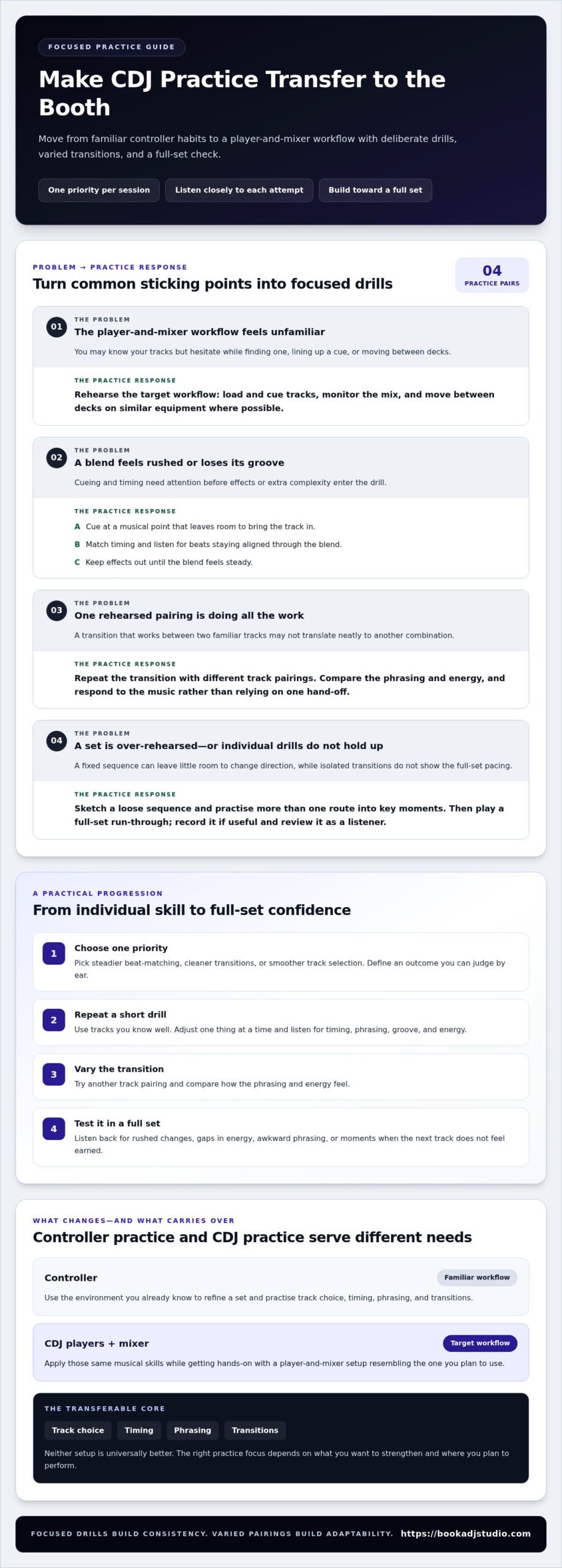
Plan a productive CDJ practice session from warm-up to full set
A strong session has a clear arc. Start by getting comfortable with the setup, isolate one skill, work on transitions, then bring everything together in a full run-through. Before you arrive, decide what you want to improve. “Work on phrasing” is more useful than “get better,” because you can listen for whether your mixes enter and resolve cleanly.
Use this repeatable sequence:
- Warm up. Load familiar tracks and settle into the player-and-mixer workflow. Focus on listening and finding your rhythm, not on delivering a perfect mix.
- Drill one skill. Work on a specific challenge, such as cueing accurately or keeping a transition aligned with the musical phrasing.
- Practise transitions. Try the same hand-off more than once, then test a different pairing or route into the next track.
- Play a full set. Put the skills together without stopping, and notice how your choices and energy flow hold up across the session.
This structure keeps practice on cdj 3000 purposeful without turning the session into a rigid routine. If a transition goes off course, make a note and keep playing. You’ll get more useful feedback from completing the run-through than from restarting every time something feels imperfect.
Prepare your music and essentials before you arrive
Get your library ready in Rekordbox before the session. Scan your tracks in Rekordbox before exporting them to a USB stick, which must be 32 GB or smaller. You can also bring prepared music on an HDD. Pack your headphones, too. At the Timișoara studio, the equipment is already powered on and configured, so arriving with your music and headphones lets you focus on the session from the start.
Turn a full run-through into useful feedback
A full set can reveal issues that don’t show up in an isolated drill. Listen back for rushed transitions, uneven energy or moments that interrupt the flow. Write down the specific passage and what you want to change, then repeat that section rather than replaying the entire set. The studio provides a wired recorder for recording a set, giving you material to review after your session.
For a local look at the DJ studio practice setup in Timișoara, explore the studio’s equipment and session options. Prepare your tracks, choose a skill to focus on and build toward a complete run-through. Ready to put your plan into action? Book studio access for your next practice session through the website.
Practise on CDJ-3000X players at a ready-to-use Timișoara studio
Turn your session plan into hands-on rehearsal at Book A DJ Studio in Timișoara. The setup includes 2 Pioneer CDJ-3000X players and 1 Pioneer DJM-V10 mixer, so you can practise transitions, set flow and performance preparation using a player-and-mixer workflow. The equipment is powered on and configured before your session, letting you focus on the mix rather than setup.
The sound system features a Yamaha DXS15 MKII subwoofer and 2 Yamaha DXR12 MKII speakers. Use the space to run a complete set, revisit a tricky transition or get comfortable moving through your music on club-style players. Practising in a dedicated environment gives you room to focus on how each track choice shapes the energy of the set.
What the studio setup lets you practise
Work through your player-and-mixer routine, then test whether your transitions and track sequence hold together across a full run-through. If you want to review or share the performance visually, three Sony ZV-E10 cameras record 4K video from three angles. The studio also has a complete livestreaming setup for sharing a practice performance live.
Choose the format that matches your goal. A focused practice session can help you refine your workflow; recording or livestreaming can add a performance context to your rehearsal. Explore the DJ studio gallery to see the practice environment before you arrive.
Book your practice session online
The studio is at Str. Cipian Porumbescu no. 76, ap. 2, Timișoara. Book online through the website form by selecting from the available days and times. Plan your session around a specific target, whether that’s getting comfortable with the setup, rehearsing a full set or capturing a practice performance.
Bring your headphones and music prepared for the session. Then give yourself space to explore the setup, make purposeful transitions and build confidence through repetition. Your next step is simple: book your CDJ practice session online and bring your set to life on the players.
Make your next session the start of something bigger
Confidence grows when practice has a purpose. Pick one element of your performance to sharpen, give yourself room to experiment, then carry what you learn into the next set. A missed cue or rough blend isn’t a setback; it’s a clear signal for what to refine next. Keep showing up, stay curious, and let each session move you closer to the sound and presence you want behind the decks.
If you’re ready to practice on cdj 3000 players in a dedicated studio, Book A DJ Studio in Timișoara has a 5.0 rating based on 8 reviews. Bring your music, focus on your craft and take the next step toward a set that feels like yours from the first track to the last.
Book your online CDJ practice session and give your next mix the space to grow. Your sound is ready for its next move.
Frequently Asked Questions
Can a beginner practise on CDJ players?
Yes, beginners can practise on CDJ players and build familiarity step by step. If you’re new to the setup, start with two tracks you know well and focus on one task, such as cueing the next track or making a simple blend. At Book A DJ Studio, you can set your own practice goal. For example, aim to make one transition feel smoother each time you repeat it.
Do skills from a DJ controller transfer to CDJ players?
Yes, core skills such as track selection, timing, phrasing and transitions remain useful across setups. The workflow and controls may feel different, though, so controller experience isn’t a substitute for hands-on time with players. If you have a gig coming up, practise the specific task that could feel unfamiliar, such as moving between tracks while monitoring the mix. Adjust gradually, and give your ears time to lead.
Do I need to prepare my music in Rekordbox before practising?
Yes. Scan your tracks in Rekordbox before exporting them to a USB stick, which must be 32 GB or smaller. You can also bring your music on an HDD. Preparing your library in advance helps you avoid spending practice time sorting files or troubleshooting an unprepared collection. Bring your headphones and choose a few tracks for your first drill, along with additional music for exploring different set directions.
Can I record a practice set at Book A DJ Studio?
Yes. A wired recorder is provided, and audio or video recording can help you review how your set sounds and looks from start to finish. Recorded mixes are uploaded and emailed to the address supplied with your booking a few days after recording, so plan to listen back later rather than expecting an immediate download. Use your notes from the session to identify a passage to refine the next time you practise.
Can I livestream a DJ practice session from the studio?
Yes. The studio has a complete livestreaming setup for sharing a DJ set on social platforms such as YouTube. Before your session, decide whether you want to test your track flow, practise performing for an audience or share a prepared set. Having a simple plan can help you stay focused while live. Bookings are made online through the website form, where you select from the available days and times.
Does Book A DJ Studio provide DJ lessons?
Book A DJ Studio is a space for independent practice, recording, livestreaming and workshops. Bring a skill you want to work on, such as beat-matching or choosing a clean mix point, and use the session to test your approach. Workshops for students and instructors are also part of the studio’s activities. For solo practice, set a clear target and use each repetition to make a small adjustment.