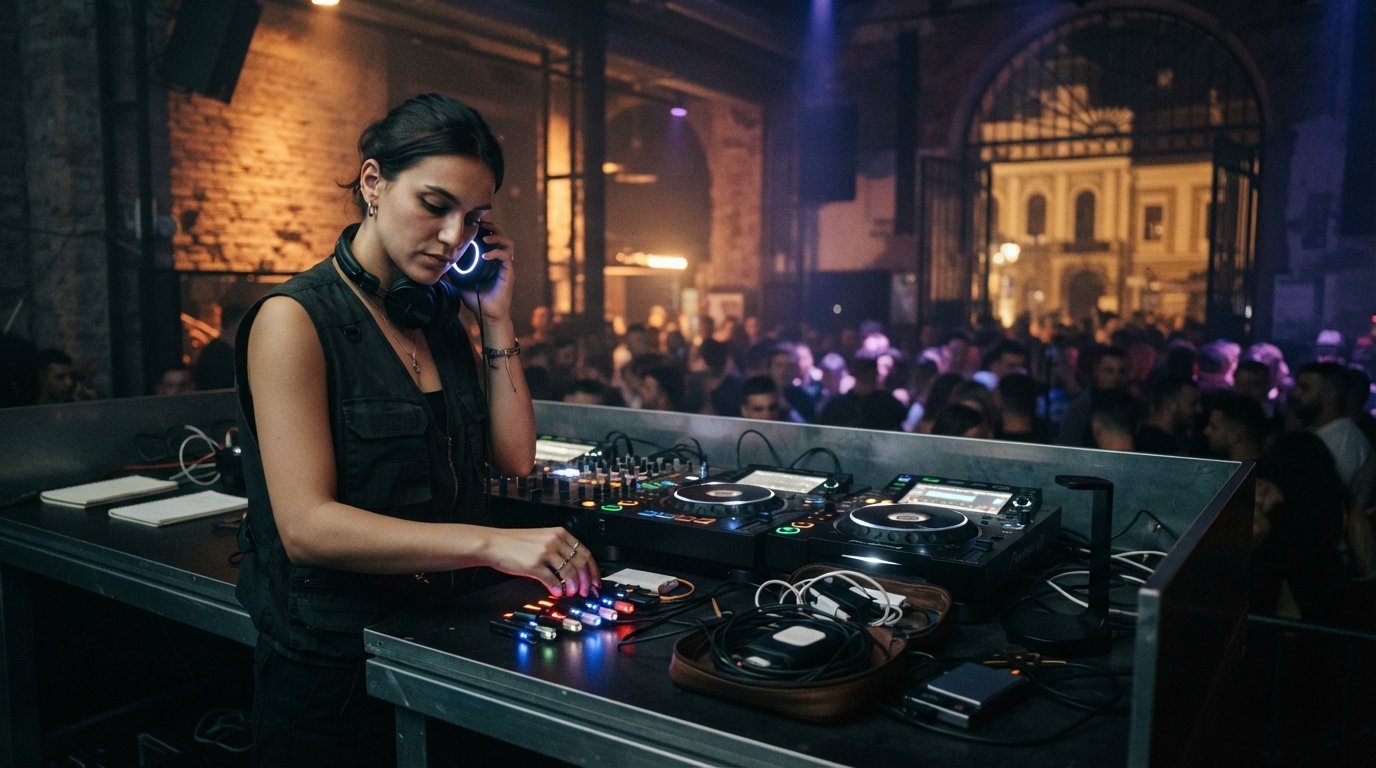

A killer club set is never pre-programmed; it is built on bulletproof preparation meeting split-second booth adaptability. If you want to know how to prepare for a club gig that commands the room, you need to approach your technical workflow with the discipline of a touring headliner.
Stepping out from behind a familiar home controller into a loud, dark booth packed with unfamiliar club-standard CDJ rigs can feel intimidating. We have all felt that sudden spike of panic when an unorganized USB drive leaves you scrolling desperately under pressure, or when a sudden jump in energy threatens to stall a packed room.
You don’t need years of residency experience to step up to the decks with total composure. With the right foundation, you can master your track preparation, conquer unfamiliar gear transitions, and execute flawless booth etiquette to crush your next live club performance. Here is your roadmap to exporting error-free USB drives, dialing in pristine mixer gain staging, and reading crowd energy to keep the dancefloor moving all night long.
Key Takeaways
- Structure your crates by energy: Curate double the music you need and organize tracks by vibe and tempo to stay agile when the dancefloor shifts.
- Master the hardware transition: Learn exactly how to prepare for a club gig by building hands-on muscle memory on club-standard media players and digital mixers.
- Pack uncompromising redundancy: Eliminate booth panic by carrying three cloned FAT32 drives, backup audio adapters, and hearing protection in your gig bag.
- Respect the booth and timeline: Arrive 45 minutes early, read the room’s energy arc, and support the night’s momentum without burning peak-hour tracks early.
- Stress-test your set in a studio: Rehearse on professional booth hardware and review recorded audio test runs to dial in flawless transitions before stepping on stage.
Organize Your Music Library and Crate Architecture
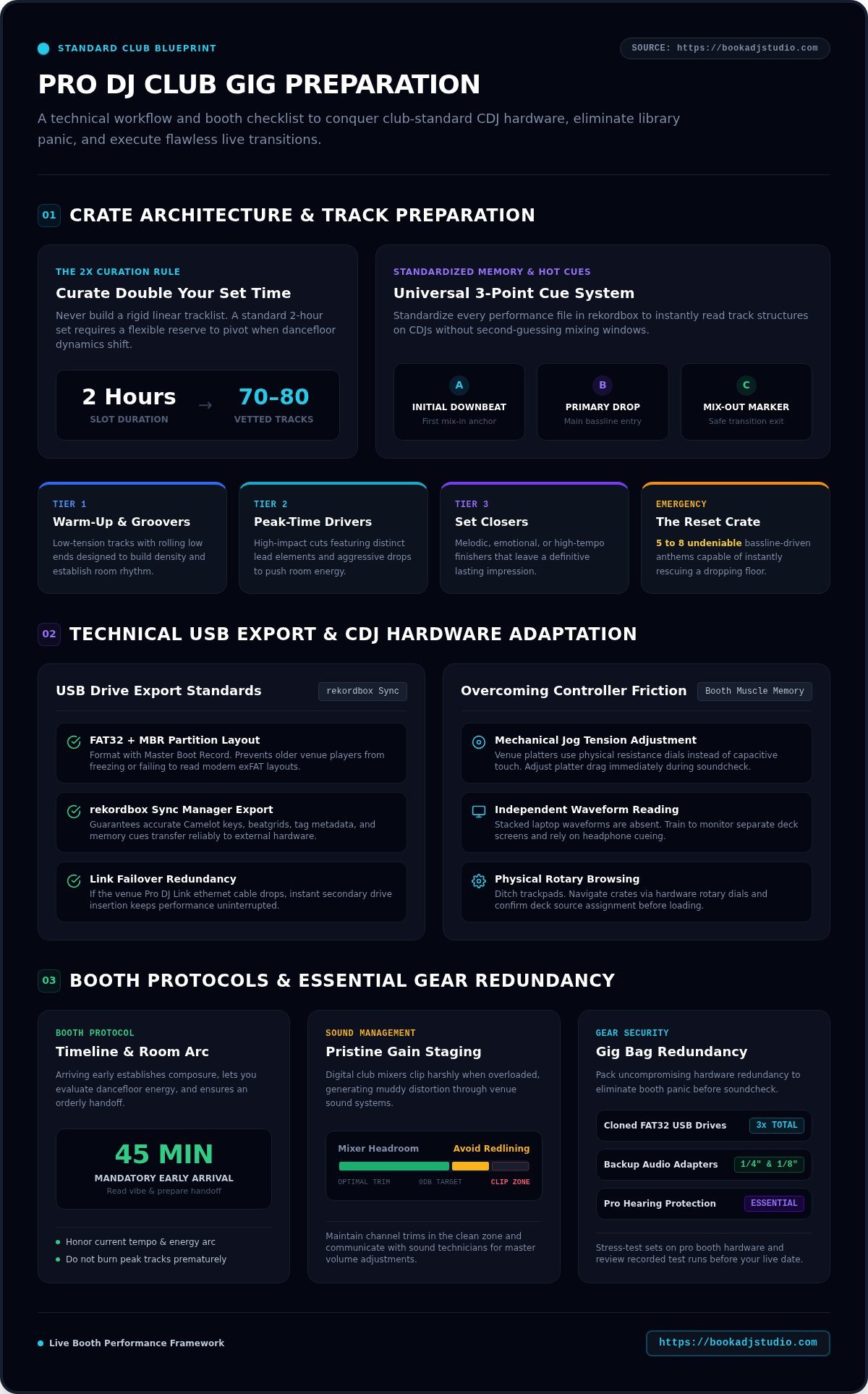
Walking into the booth with a rigid, track-by-track setlist is a recipe for disaster. The crowd might want darker grooves than you planned, or the previous selector might leave the floor at a tempo you didn’t expect. When planning how to prepare for a club gig, your music library must balance razor-sharp organization with live flexibility. Always curate at least double the music needed for your set time. A two-hour slot requires at least 70 to 80 vetted tracks, giving you the freedom to pivot without running out of options.
Every track must pass through a strict preparation protocol before it touches hardware. Analyze your files thoroughly in rekordbox to confirm accurate beatgrids and Camelot key detection. Standardize your memory cues and hot cues across every performance file: place Cue A on the initial downbeat, Cue B at the primary bassline drop, and Cue C at the mix-out marker. This consistency lets you instantly read track arrangements on club-standard CDJ media players without second-guessing your mixing windows.
To visualize how touring artists build adaptable set frameworks, watch this workflow breakdown:
Energy-Based Playlist Structuring
Ditch linear tracklists. Instead, divide your session into dynamic energy tiers that let you react to the room:
- Warm-Up & Groovers: Low-tension tracks with rolling low ends designed to build room density.
- Peak-Time Drivers: High-impact cuts featuring distinct lead elements and aggressive drops.
- Set Closers: Melodic, emotional, or high-tempo finishers that leave an impression.
- The Reset Crate: Five to eight undeniable, bassline-driven anthems that can rescue a dropping floor instantly.
Rekordbox Preparation and USB Exporting
Technical export errors ruin sets before they begin. Format your primary and backup USB drives using FAT32 with a Master Boot Record (MBR) partition. While newer gear handles exFAT, older venue players will freeze or fail to read modern partition layouts. Use the rekordbox Sync Manager to export your playlists, guaranteeing that all cue points, waveforms, and tag metadata transfer cleanly. When learning how to prepare for a club gig like a touring professional, carry at least two identical, cloned USB drives. If an ethernet Pro DJ Link cable fails between booth players, you can instantly slot your backup drive into the secondary deck and keep mixing seamlessly.
Master Club-Standard Hardware Before Stepping Into the Booth
Home controllers with lightweight, capacitive touch jog wheels feel radically different from a venue installation. When you step into a dark booth, you face mechanical jog wheels with adjustable tension dials, separate multi-channel mixers, and unfamiliar layouts. Understanding how to prepare for a club gig means conditioning your physical muscle memory so you aren’t hunting for essential knobs under pressure.
Overcoming Controller to CDJ Friction
Most home setups rely on laptop screens displaying parallel, stacked waveforms. In a pro booth, that visual crutch vanishes. Each media player operates independently, requiring you to read individual displays and trust your headphone cueing. Keep these hardware fundamentals top of mind:
- Physical Navigation: Practice selecting tracks using the large rotary browse knob and back buttons rather than a mouse or trackpad.
- Platter Resistance: Mechanical jogs feature a tension knob on the top right. Adjust it to match your backspinning and nudging preferences immediately during soundcheck.
- Source Routing: Learn how Pro DJ Link works across linked decks. Confirm your media source selection before hitting load so you never overwrite an active live deck.
Gain Staging and Booth Sound Management
Nothing screams amateur faster than redlining the mixer. Digital club mixers clip harshly when pushed past their operating limits, sending muddy distortion through high-end club sound systems. Keep your channel trim levels peaking in the high green or first two amber LEDs. The master output fader belongs to the front-of-house sound engineer; keep your hands off it.
Manage your immediate soundscape using the booth monitor control. High monitor volumes cause rapid ear fatigue, compromising your mixing precision. Booth audio levels routinely exceed 100 dB. According to CDC research on safe listening at music venues, exposure to extreme sound levels can cause permanent hearing damage in minutes, making high-fidelity acoustic earplugs an absolute necessity in your setup.
Building real confidence behind the mixer takes tactile practice. Booking a session in a professional studio booth allows you to master full-sized gear, test your USB drives, and refine your gain staging long before your live set begins.
The Essential DJ Gig Bag Checklist: Pack for Every Scenario
Primary Audio Gear and Critical Spares
Never rely on a promoter or venue to supply basic connection points. Build your core audio kit around heavy redundancy:
- 🎧 DJ Headphones: Pack durable, closed-back headphones that isolate external room rumble, complete with a modular, detachable cable.
- 🔌 1/4-Inch (6.35mm) Adapters: Carry two screw-on and two slip-on adapters. Keep one screwed onto your headphone cable and stash the spares in your wallet so you never get locked out of a mixer jack.
- 💾 The Rule of Three USBs: Bring three identical flash drives formatted to FAT32. Run Deck 1 and Deck 2 independently if the Pro DJ Link switch fails, and keep the third in your pocket as an emergency reserve.
- 👂 High-Fidelity Earplugs: Sound levels behind the decks easily climb past 100 dB. Custom-molded or filtered acoustic plugs preserve your frequency perception while protecting your ears from permanent tinnitus.
Emergency Connectivity and Backup Tools
Unforeseen hardware hiccups happen in real clubs. Power surges knock out multiplayers, linked hubs disconnect, and poorly lit corners make reading port labels nearly impossible. Learning how to prepare for a club gig means anticipating these exact friction points before they derail your set.
Stash a shielded 3.5mm-to-RCA cable in your bag. If an entire multiplayer system crashes mid-night, this single cable lets you run an emergency mix directly from your phone into an open mixer channel while the venue tech reboots the main rig. Keep a spare Cat5e/Cat6 ethernet cable handy to instantly rebuild a broken link connection between two players. Round out your kit with a compact LED flashlight for peering behind dark flight cases, a portable power bank to keep your phone charged for track IDs, and a strip of black gaffer tape to secure loose headphone cables.
Booth Etiquette and Reading the Room
Your technical skill gets you booked once; your booth etiquette gets you booked repeatedly. Arrive at the venue at least 45 minutes before your scheduled set time. Stepping onto the floor early lets you gauge the room’s acoustic profile, track how the crowd reacts to specific tempos, and greet the sound technician. Knowing how to prepare for a club gig involves reading the social and physical environment just as sharply as you read your waveforms.
Slot Awareness and Crowd Psychology
Every timeslot demands a distinct musical responsibility. If you have the opening slot, your goal is to pull people from the bar toward the dancefloor without burning the headliner’s peak tracks. Build subtle, hypnotic grooves that leave room for the night to escalate. Playing high-octane bangers to an empty room clears the floor and frustrates promoters.
Observe body language constantly while performing. When heads are nodding and feet are shuffling, hold your pocket groove steady. If dancers check their phones or drift toward the smoking terrace, smoothly pivot your energy tier or shift subgenres using your pre-mapped reset tracks. To see how rising selectors build durable industry relationships across regional venues, check out our Timișoara DJ community resource guide.
Executing the Flawless DJ Handover
The transition between two DJs must feel invisible to the dancefloor. Execute the handover with clear, non-verbal respect:
- 👀 Approach with Caution: Enter the booth 10 minutes prior to your start time. Wait until the current DJ finishes an active blend before making eye contact or saying hello.
- 🎧 Confirm Routing: Ask which channel and deck are free. Never pull out an outgoing DJ’s USB drive until their track has stopped playing and their screen confirms the deck is idle.
- 🎚️ Match the Pacing: Lock your first track to the outgoing DJ’s tempo and tonal mood. Abruptly slicing the BPM or radically dropping the energy shatters the room’s momentum.
- 🧹 Clear Your Footprint: When your set ends, immediately collect your USBs, wipe down sweat or spills from the mixer faceplate, pack your headphones, and step aside.
Treating bar staff, security, and sound engineers with genuine courtesy builds lasting goodwill. If you want to test and refine your live set transitions before your next performance, book studio access to practice uninterrupted in an authentic booth setting.
Rehearse Your Set in a Professional Studio Environment
Bedroom practice gets you comfortable with transitions, but it cannot prepare you for the physical intensity of a real venue. Living room speakers hide low-end phase clashes, and compact controllers mask the sheer scale of a festival-grade booth. If you want to know how to prepare for a club gig with total confidence, bridge the gap between home mixing and high-stakes performance inside an acoustically optimized studio space.
Eliminating Performance Anxiety Through Tactile Practice
Opening-track anxiety vanishes when your hands already know the hardware. Lock in your tactile muscle memory before doors open:
- 🔊 Full-Length Dress Rehearsals: Run an uninterrupted 60-to-90-minute set. If you drift off-beat or mistime a phrase, force yourself to recover live instead of stopping to restart the track.
- 🎛️ True Acoustic Pressure: Blast your library through dedicated, high-output booth monitor wedges. Feeling physical sub-bass rumble teaches you how your low-end EQ cuts translate on a massive sound system.
Booking dedicated booth time at a specialized studio DJ pentru practică gives you hands-on access to flagship club multiplayers, stripping away opening jitters before your call time.
Record and Refine Your Live Performance
Honest self-evaluation separates weekend hobbyists from standout headliners. You cannot objectively judge track synergy or EQ balance while actively focusing on cueing and beatmatching:
- 🎙️ Direct Line Audio Recording: Capture uncompressed master audio straight from the mixer. Listen back critically on studio headphones to spot clashing frequencies, rushed builds, or volume inconsistencies across different track masters.
- 📹 Multi-Angle Visual Feedback: High-definition multi-camera recording lets you review your booth posture, stage presence, and operational pacing. Identify whether you look relaxed and engaged or buried in track menus.
Dialing in your technical mechanics transforms nervous energy into commanding stage presence. Lock in your rehearsal slot and gear up for your live debut through the Book a DJ Studio reservation section to step up to the decks primed to crush every blend.
Claim Your Place Behind the Club Decks
Mastering how to prepare for a club gig isn’t about memorizing every transition track by track; it’s about building unflinching trust in your technical execution. When you replace rigid setlists with flexible energy tiers, pack reliable hardware redundancies, and respect the natural flow of the room, performance anxiety turns into pure creative confidence.
Every great headliner started with deliberate practice. Don’t leave your live set to chance on unfamiliar venue gear when you can test your muscle memory beforehand. Fine-tune your transitions on industry-standard CDJ and DJM setups, evaluate your pacing with crystal-clear direct audio capture, and dial in your stage presence with 4K multi-cam recording in an authentic booth environment.
Ready to command the room and own your sound? Book your rehearsal session at Book a DJ Studio in central Timișoara and step onto the stage completely booth-ready.
Frequently Asked Questions
How many tracks should I prepare for a one-hour club set?
Aim for 35 to 50 vetted tracks for a one-hour slot. Even if you only mix 15 to 20 selections live, carrying double or triple that amount provides the flexibility you need to steer the room. Knowing how to prepare for a club gig means packing enough depth across tempos and moods so you never get boxed into a corner if the vibe shifts unexpectedly.
What should I do if my USB drive fails or throws an error in the booth?
Switch immediately to your cloned backup drive without drawing attention to the issue. If the primary deck freezes, keep audio playing on the secondary channel while you reboot the frozen unit. Plug your second drive directly into the free player if Pro DJ Link drops. Having three mirrored FAT32 drives ensures an error never halts the music or derails your momentum.
Can I prepare a set on a home controller and play on CDJs without issues?
You can, provided you export your library properly through rekordbox and adapt to tactile hardware changes. Home controllers rely on laptop screens and light jog wheels, whereas club CDJs require browsing on standalone displays and handling mechanical platters. Rehearsing at a local studio space in Timișoara before your gig builds the physical familiarity you need to transition seamlessly without technical surprises.
How early should I arrive at the club before my set begins?
Plan to arrive 45 to 60 minutes before your slot kicks off. Getting there early gives you time to check in with the promoter, meet the front-of-house sound engineer, and soak in the room’s energy. You will hear how the acoustic profile reacts to a growing crowd and observe what tempos the current DJ is exploring, setting you up for a smooth start.
What is the proper etiquette when taking over from the previous DJ?
Step quietly into the booth roughly ten minutes before your set without interrupting their mixing flow. Ask which channel and deck are available for your opening track, and never remove their flash drive until their channel fader is down and their deck is completely stopped. Match their outgoing tempo on your first track to keep the dancefloor moving without jarring pauses.
Is it okay to play pre-planned sets, or should I improvise entirely?
Plan structured mini-routines or track pairings, but never lock yourself into a rigid, track-by-track setlist. Understanding how to prepare for a club gig means preparing flexible crates grouped by energy tiers rather than fixed playlists. Have a solid opening track and a few reliable fallback anthems ready, but let the crowd’s real-time energy dictate where the journey goes next.
How can I prevent redlining and sound distortion on a club mixer?
Keep your individual channel gains dialed into the amber range and well out of the red zone. Redlining introduces harsh digital clipping that sounds terrible on large club sound systems and triggers front-of-house limiters. If you struggle to hear details in the booth, boost your booth monitor knob or headphone level rather than cranking the mixer’s master output.