What if the secret to a legendary debut isn’t just your tracklist, but how you handle the transition from your bedroom controller to the heavy-duty gear in a dark, loud booth? Learning how to prepare for your first DJ gig is the bridge between being a bedroom DJ and becoming a respected professional in the local scene. It’s natural to feel that rush of adrenaline mixed with a bit of “what if the software crashes?” panic. You want to focus on the music, but the fear of technical glitches or a messy transition on unfamiliar gear is holding you back.
We’ve been there, and we understand the pressure of making a great first impression. This guide will transform those pre-gig nerves into pure, professional confidence by giving you a battle-tested roadmap. You’ll learn exactly how to optimize your Rekordbox 7.2.16 library, master club-standard equipment, and use recording tools to analyze your performance before you even step into the booth. From organizing your stems to managing your setup time, we’re covering the essential steps to ensure your first set is flawless and your reputation starts growing from night one.
Key Takeaways
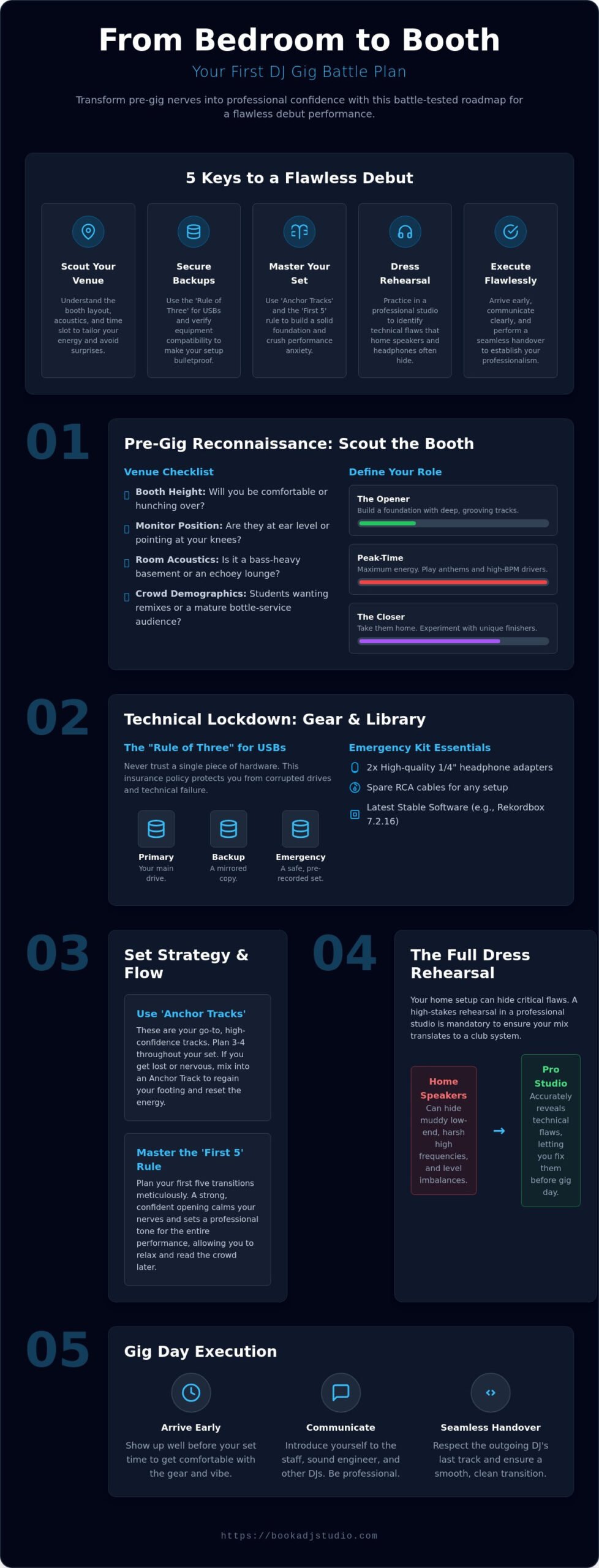
- 📍 Scout your venue and understand your specific time slot to tailor your energy and eliminate booth-layout surprises.
- 🛡️ Secure your performance with the ‘Rule of Three’ for USB backups and verify house equipment compatibility before you arrive.
- 🚀 Master how to prepare for your first DJ gig by using ‘Anchor Tracks’ and the ‘First 5’ rule to crush performance anxiety.
- 🎧 Conduct a high-stakes dress rehearsal in a professional studio to identify technical flaws that home speakers often hide.
- 🤝 Execute a seamless handover and arrive early to establish the professional image needed for recurring club bookings.
Scouting the Booth: Researching Your Venue and Audience
Your first gig isn’t won in the booth; it’s won in the weeks leading up to it. Understanding how to prepare for your first DJ gig starts with a deep dive into the environment you’re about to inhabit. Don’t be the artist who walks in blind. Visit the venue at least once before your scheduled date. Walk up to the booth. Is it at waist height or will you be hunching over for two hours? Check where the monitor speakers are positioned. If they’re pointing at your knees instead of your ears, you’ll need to adjust your headphone volume to compensate.
Listen to the room’s acoustics. A concrete basement in Timișoara eats high frequencies and booms with bass, while a high-ceiling lounge might have a distracting echo. Adjust your track selection to fit the physical space. Define your role clearly:
- The Opener: Build the foundation. Keep it deep and grooving.
- Peak-Time: Maximum energy. Play the anthems and high-BPM drivers.
- The Closer: Take them home. Experiment with weird, hypnotic, or high-energy finishers.
Analyzing the headliner is equally vital. Respect the vibe by staying away from their signature tracks. If they’re known for a specific remix, don’t play it. You’re there to complement the night, not compete with the main attraction.
To better understand this concept, watch this helpful video:
The Opening DJ Etiquette
If you’re booked as the opener, your job is to set the table, not eat the meal. Much like how a professional host uses quality kitchenware from oalamea.ro to create the perfect dining environment, your job is to craft the ideal musical atmosphere. Playing peak-time bangers at 10:00 PM when the floor is empty is the fastest way to get blacklisted by promoters. You’re crafting a xslow burn. Focus on groove and atmosphere. Keep the energy levels at a steady simmer, leaving plenty of headroom for the headliner to explode. Communicate with the sound engineer early. Introduce yourself, ask about the house limits, and respect their red lights. A professional relationship with the staff is just as important as the music you play.
Understanding the Crowd Dynamics
Who is on the dancefloor? Scouting the demographic is crucial. Is this a student crowd looking for high-energy remixes or a more mature audience spending 500 lei on premium bottles? Learning how to prepare for your first DJ gig involves more than just beatmatching; it’s about psychological warfare with the dancefloor. Align your set with the How to Launch a Successful DJ Career in Romania framework to ensure your style matches local market expectations. Read the room before you touch the mixer. Watch how people react to the background music. If they’re tapping feet to tech-house but ignoring melodic techno, take note. You’re a performer, but you’re also a service provider. Your goal is a packed floor and a happy promoter.
The Technical Lockdown: Preparing Your Gear and Library
Technical failure is the only thing that can stop a great set in its tracks. You’ve spent weeks digging for tracks; don’t let a faulty cable or a corrupted USB drive kill the vibe. When learning how to prepare for your first DJ gig, your technical prep must be bulletproof. Start by confirming the hardware. Will you be plugging your laptop into a controller, or are you stepping up to the house CDJs? Most professional booths in Romania rely on Pioneer DJ setups. If you’re used to a small controller at home, the jump to a club mixer can feel like stepping into a cockpit. Lock down your gear list early so there are no surprises when you plug in.
Never trust a single piece of hardware. The “Rule of Three” for USBs is your insurance policy. Carry one primary drive, a mirrored backup, and a third “emergency” drive containing a pre-recorded mix or a “safe” set of crowd-pleasers. Ensure you’re running the latest stable software; as of July 2026, Rekordbox 7.2.16 is the standard for preparation. Use this software to set hot cues for your mix-in and mix-out points. Active loops are a lifesaver if a transition is going long and you need to buy time. Pack an emergency kit in your bag. It should include:
- Two high-quality 1/4 inch headphone adapters (one will inevitably go missing).
- A pair of spare RCA cables and a shielded USB-B cable.
- A high-speed SanDisk Extreme Pro USB drive (formatted correctly).
- Earplugs for when you aren’t behind the decks.
Mastering the Club Standard
Transitioning from a bedroom controller to Professional DJ Equipment in Timișoara is the ultimate rite of passage. In 2026, knowing the Pioneer CDJ layout is non-negotiable. You need to be comfortable navigating the touchscreen and using the physical browse knob without looking down at a laptop screen. Have a “Plan B” ready. If the Pro DJ Link cable fails between players, you need to be able to switch to your backup USB on the second deck instantly. Before you step into the lights, make sure your files actually load on a pro setup by locking in a practice session on the real deal.
Library Hygiene and Exporting
Clean data equals a clean performance. Analyze every track for BPM and Key using the Camelot Wheel system. This makes harmonic mixing effortless during high-pressure moments. When exporting for CDJs, your USB must be formatted to FAT32 or HFS+. Anything else might result in a “Format Error” right when the previous DJ hands you the headphones. Don’t forget to configure your “My Settings” in Rekordbox. This allows the decks to automatically load your preferred vinyl mode, quantization, and jog wheel resistance the moment you plug in your drive.
Set Strategy: Planning Your Journey Without Losing Flexibility
Don’t walk into the booth with a random folder of 500 tracks and hope for the best. That is a recipe for choice paralysis. Professional set strategy is about creating a flexible framework that supports your creativity while protecting you from panic. You need to know exactly how to prepare for your first DJ gig by balancing rigid planning with real-time intuition. A successful set is a journey, not a playlist. Structure your library into these four tactical layers:
- 🚀 The Anchor Tracks: Pick 10 songs you know will work. These are your “secret weapons” to deploy if the energy dips.
- 🛡️ The First 5 Rule: Script your first 15 minutes. This settles your hands while the adrenaline is spiking.
- 🔄 The Pivot Playlist: Create folders for “Empty Floor” vs. “Peak Energy.” Be ready to change direction instantly.
- 🆘 The Bail-out Track: Keep an 8-minute classic ready. It buys you time to fix a cable or take a quick breather.
The ‘First Five’ Confidence Builder
The first 15 minutes are a psychological battle. Your heart is racing. Your hands might shake. This is the “adrenaline dump.” By scripting your intro, you eliminate technical risk during your most vulnerable moments. Focus on simple, clean transitions. Use loops to extend your intro track if the previous DJ finishes their set two minutes early. It gives you time to breathe, check your gain levels, and scan the crowd. Once you survive the first five tracks, the nerves vanish and the flow state takes over.
Reading the Floor in Real-Time
Stop looking at your waveforms and start looking at the people. Identifying “The Dancer” is a pro move. There’s always one person who is locked into your sound. Play for them first, and the rest will follow. Energy management is a delicate balance. Don’t push the BPM too fast too early. Let the room breathe. If you want to perfect this flow before the big night, check out our guide on finding a Studio DJ pentru Practică in Timișoara. Practicing your transitions in a pro environment helps you master how to prepare for your first DJ gig without the distractions of your bedroom. Watch the crowd’s body language. If they’re moving to the bar, it’s time to deploy an Anchor Track and win them back.
The Full Dress Rehearsal: Why Pro Practice is Mandatory
Your bedroom is a safe zone. The club is a high-stakes environment. Small home speakers or headphones often hide messy transitions and “muddy” bass that sound disastrous on a massive club system. To truly master how to prepare for your first DJ gig, you must escape the comfort of your room. You need to hear your tracks through professional, sound-optimized monitors that expose every gain staging error and clashing key. This is where you find out if your transitions are actually smooth or if you’ve just grown used to your home setup’s limitations.
Simulate the real pressure of the booth. Turn off your laptop screen or cover the waveforms. Pro DJs rely on their ears and the physical feedback of the hardware. If you can’t mix without visual aids, you aren’t ready for the lights. Practice your entire set from start to finish without stopping. If you make a mistake, don’t hit restart. Learn to recover in real-time. This builds the mental muscle memory needed to stay calm when you’re standing in front of a live crowd in Timișoara.
Recording for Breakthroughs
Audio is only half the story. High-quality Audio & Video Recording is the ultimate truth-teller for a developing artist. When you watch a 4K video of your rehearsal, you’ll spot “panic nudges” on the jog wheel or awkward posture that kills your booth presence. Seeing yourself perform helps you transition from a nervous beginner to a confident performer. Use the audio recording to listen for gain spikes. If your levels are constantly hitting the red during the rehearsal, you risk distorting the club’s sound system or getting a lecture from the sound engineer.
The Studio Advantage in Timișoara
Using Professional DJ Studio Rental in Timișoara is like an athlete training in a high-performance facility. It removes the distractions of home and puts you in a sound-optimized space with club-standard Pioneer gear. You’ll get comfortable with the physical layout of the decks, ensuring you won’t be fumbling for the browse knob at the venue. This is the essential bridge between home practice and club reality. By the time you finish your studio session, you’ll know exactly how to prepare for your first DJ gig with total technical certainty.
Ready to hear what your set really sounds like on pro gear? Book your professional studio session today and dominate your debut.
Gig Day Execution: Dominating the Booth from Start to Finish
The sun is down, the lights are up, and your USBs are in your pocket. This is the moment where your preparation meets reality. Understanding how to prepare for your first DJ gig culminates in these final hours. Arrive at the venue at least 45 minutes before your set time. This isn’t just about being polite; it’s about survival. You need to hear the room’s current energy, check the monitors, and see how the previous DJ is using the mixer. Every club system reacts differently to bass frequencies. Standing on the floor for 15 minutes gives you a clear picture of what the crowd is actually hearing.
The handover is your first technical hurdle. Don’t be the artist who rushes the booth and creates an awkward silence. Approach the current DJ during a break in their workflow. Ask which channel they’re using and if they’re using the Pro DJ Link. When it’s time to switch, beatmatch your first track in your headphones until it’s locked. A smooth, seamless transition is the hallmark of a professional. Once you’re in control, focus on your booth presence. Look up from the decks. Smile. Engage with the crowd. In the Timișoara scene, people connect with the performer as much as the music. If you look like you’re having the time of your life, the dancefloor will too. This principle of crowd engagement is universal across all live entertainment; for instance, the success of a חגיגה ישראלית עם יואב חסיס relies entirely on the artist’s ability to lead and energize the room through live music.
Managing the Adrenaline
The “first track jitters” are a biological certainty. Your heart will race, and your hands might feel cold. Use box breathing techniques-inhale for four seconds, hold for four, exhale for four-to center yourself before you touch the jog wheel. Avoid the temptation of “free drinks” until your set is over. Alcohol dulls your high-frequency hearing and slows your reaction time. You’ve already done the hard work during your dress rehearsal. Trust the preparation you did at the studio. Your muscle memory knows exactly where the knobs are. Let the music take over.
Securing the Residency
Your performance ends when you leave the building, not when you stop the music. The secret to how to prepare for your first DJ gig involves thinking about the second one. Be low maintenance. Don’t redline the mixer; keeping your levels out of the red makes the sound engineer’s life easy and keeps the audio crisp. After your set, find the promoter and the staff. A simple “thank you” goes a long way. Promote the venue on your social media. Tag the club in your stories and share high-quality clips of the night. When a promoter sees that you’re talented, professional, and easy to work with, you become their first choice for the next lineup.
Ready to unleash your sound? Book Now and dominate the booth with the confidence of a seasoned pro.
Step Into the Booth With Authority
Your first set is the start of something massive. You’ve learned that mastering how to prepare for your first DJ gig is about more than just track selection. It’s about technical precision, crowd psychology, and obsessive preparation. From scouting the booth height to locking down your USB redundancy, every detail you’ve planned builds a foundation of professional confidence. You’re no longer just a bedroom enthusiast. You’re a performer ready to control the room and secure your next booking.
Don’t leave your debut to chance. You need a private, sound-optimized space to iron out every transition. Our studio provides a club-standard Pioneer CDJ and DJM setup. Use our 4K video recording to analyze your booth presence and technical flow before the club lights go up. This is the essential bridge between home practice and club reality. Ready to crush your first gig? Book your professional rehearsal session in Timișoara now!
The dancefloor is waiting for your unique sound. Trust your preparation. Trust your ears. Go out there and dominate the night.
Pro Performance FAQs
Should I pre-plan my entire first DJ set?
No, scripting every transition makes you too rigid to react to the dancefloor. Plan your first 15 minutes to settle your nerves and manage the initial adrenaline spike. Beyond that, rely on your prepared folders and anchor tracks. This allows you to read the room and pivot if the crowd reacts better to a different energy level than you originally expected.
What do I do if the DJ equipment fails during my set?
Stay calm and deploy your technical backups immediately. If a deck freezes, use your “Rule of Three” emergency USB on the functioning player. If the sound cuts out, don’t panic. Check your cables first, then signal the sound engineer. Keeping a cool head is the difference between a minor glitch and a set-ending disaster. Your professional reputation depends on how you handle the silence.
How many songs should I bring for a one-hour gig?
Bring at least 40 to 60 tracks for a 60-minute slot. You will likely only play 15 to 25 songs, but having three times that amount ensures you never run out of music. This variety gives you the freedom to move between sub-genres or energy levels. It’s better to have 30 tracks you don’t use than to be stuck with five minutes left and no music.
Is it okay to use the ‘Sync’ button at my first club gig?
Yes, using sync is a valid choice as long as your Rekordbox beatgrids are perfectly analyzed. Using this tool allows you to focus on EQing, effects, and track selection while learning how to prepare for your first DJ gig in a high-pressure environment. However, always be ready to beatmatch by ear if the software misreads a track or the link cable fails.
How do I handle the transition from the previous DJ?
Communication is the key to a professional handover. Enter the booth 10 minutes early and ask the current DJ which channel they are using. Beatmatch your first track in your headphones to their outgoing song. Wait for a natural phrase change or a breakdown to bring your fader up. Never stop their music abruptly; aim for a transition that the crowd barely notices.
What should I do if the dance floor is empty?
Focus on the groove and don’t try to “force” the floor with peak-time bangers. Use your pivot playlist designed for lower energy. Your goal is to make the people at the bar or tables feel the rhythm. Once you see heads nodding and feet tapping, gradually increase the energy. Playing the right music for three people is more professional than playing the wrong music for zero.
Do I need to bring my own headphones and adapters?
Yes, always bring your own headphones and at least two 1/4 inch screw-on adapters. Relying on the venue for gear is a rookie mistake that can ruin your night. Part of knowing how to prepare for your first DJ gig is being entirely self-sufficient. Having a spare adapter in your pocket ensures that a lost small part won’t stop you from plugging into the mixer.
Can I record my first gig to use for promotion?
You can, but always get permission from the promoter and the sound engineer first. Use a portable recorder connected to the “Rec Out” on the mixer for the best audio quality. A clean recording of your debut is a massive asset for social media and future bookings. It proves to other promoters in Romania that you can handle a live crowd and a professional booth.