What if your laptop screen suddenly went black in the middle of a headline slot? You’ve spent months practicing, but if you’re still relying on visual waveforms, that’s a nightmare scenario. It’s a common frustration; 64% of DJs want to upgrade to club-standard AlphaTheta hardware, yet many feel paralyzed when the sync button isn’t an option. This beatmatching guide will help you master the physical muscle memory required to align tracks by ear and transform your sets into seamless experiences.
You already know that tracks drifting apart is the fastest way to lose a crowd’s energy. We’ll show you how to tame the pitch fader and gain the professional credibility needed to play on any gear, from a DDJ-FLX10 to the latest AlphaTheta DJM-V5. From understanding tactile feedback to executing perfect transitions on 2026-standard gear, you’re about to bridge the gap between your bedroom and the main stage. Let’s bring your passion to life; your next big gig starts with mastering the fundamentals.
Key Takeaways
- Discover why manual beatmatching remains the essential safety net for professional DJs when the sync button is not an option.
- Master the mechanics of BPM and phasing to ensure your kicks and claps align perfectly every time you drop a track.
- Follow this beatmatching guide to find the “one” and execute flawless cueing that keeps the dancefloor moving.
- Sharpen your ears with high-impact practice drills like the “Blindfold Test” to build the physical muscle memory needed for high-pressure sets.
- Learn why practicing on club-standard hardware in a professional studio environment is the fastest way to gain club-ready confidence.
Why Every DJ Needs a Solid Beatmatching Foundation
Beatmatching is the fundamental art of synchronizing two tracks’ tempos and phases entirely by ear. It’s the difference between being a “playlist selector” and a true performer. While 41% of DJs are excited about streaming integration, the core of the craft hasn’t changed since the first vinyl decks hit the scene. You need to hear the drift before the crowd does. This beatmatching guide will help you develop the sharp ears required to dominate any dancefloor.
The Sync button is a powerful tool in a 2026 workflow, especially when using AI-powered stem separation to create instant mashups. However, it’s not a crutch. Software analysis often fails on tracks with live drums, classic disco, or complex polyrhythms. If your Rekordbox grid is off by even a millisecond, your mix will sound messy. Mastering manual techniques ensures you can save any transition when the technology falters. It’s your gateway to the “flow state,” where you stop staring at a screen and start feeling the rhythm.
The Professional Edge: Why Ear-Matching Matters
Your ears are more reliable than any algorithm. Software glitches happen. Since nearly 60% of DJs own Pioneer DJ or AlphaTheta hardware, you must be ready for the tactile response of a physical pitch fader. Professional credibility is earned when you can walk into any booth and handle the mix even if the waveforms are missing or the software crashes. This skill allows for advanced creative layering. When you aren’t fighting the software, you can focus on using the AlphaTheta RMX-Ignite or Korg Kaoss Pad V to transform your set into a unique performance. 🎧 Control your sound. 🚀 Command the room.
Transitioning from Hobbyist to Artist
There’s a specific moment when beatmatching shifts from a conscious struggle to pure muscle memory. You stop overthinking the “nudge” and start trusting your instincts. This transition is vital for anyone looking to play in high-energy club environments. To reach that level, you need to practice on the same gear the pros use. Booking time at Book a DJ Studio gives you access to the club-standard setups you’ll find on stage. It’s the most cost-effective way to build confidence without the 35,000 lei price tag of a personal pro setup. 🎧 Practice hard. 🚀 Get club-ready.
The Anatomy of a Perfect Beatmatch: BPM, Phasing, and Nudging
Mastering the technical pillars of a mix is what separates a bedroom hobbyist from a professional artist. To get it right, you need to understand how BPM, phasing, and nudging work in harmony. BPM is your speed. Phasing is your alignment. Nudging is your correction. This beatmatching guide breaks down these mechanics so you can stop guessing and start performing. Learning how to beatmatch by ear requires a deep understanding of these elements before you even touch a mixer.
BPM, or Beats Per Minute, is the heartbeat of your track. If Track A is at 124 BPM and Track B is at 126 BPM, they’ll never stay together. You use the pitch fader to match these numbers. Phasing is the next step. Even if the speeds match, the beats must hit at the exact same time. If the “kicks” of both tracks aren’t aligned, you’ll hear a “galloping” sound that ruins the energy. Professional DJs listen for the transients, the sharpest part of the drum hit, to ensure the phase is locked.
Understanding the Pitch Fader
The pitch fader is your primary tool for speed control. Most club-standard gear offers ranges of +/- 6%, 10%, and 16%. Use the 6% setting for house or techno where you need surgical precision. The 10% range is the industry standard for most transitions. “Riding the pitch” is a pro technique where you adjust the fader instead of the jog wheel to fix drifting tracks. It creates a much smoother correction that the crowd won’t notice. 🎧 Master the fader. 🚀 Lock the tempo.
The Jog Wheel: Nudging vs. Scratching
Think of the jog wheel as two different tools. The top plate is for vinyl mode and scratching. The outer rim is for nudging. When a track is slightly behind, a gentle clockwise twist on the rim speeds it up momentarily. A counter-clockwise twist slows it down. Common mistakes include applying too much pressure or “spinning” the wheel, which leads to a total train wreck. You only need a millisecond of correction. Practice this tactile feedback on professional gear at Book a DJ Studio to develop the delicate touch required for the booth. 🎧 Feel the wheel. 🚀 Perfect the nudge.
Step-by-Step: How to Beatmatch by Ear Like a Pro
Ready to move from theory to action? This beatmatching guide provides the tactical checklist you need to execute flawless transitions without looking at a screen. Start by choosing two tracks with similar BPMs and simple 4/4 structures. Pick a solid house beat with a clear kick drum to make your first few sessions easier. Find the “One,” which is the very first beat of a musical phrase, and hold it ready. Launch your cue track exactly when the master track hits its next phrase start. 🎧 Timing is everything. 🚀 Feel the beat.
Once the track is live in your headphones, listen for the “gallop.” If you hear a double kick drum, you’re out of phase. Identify if the new track is rushing ahead or dragging behind. Nudge the jog wheel rim to realign the tracks instantly. If they keep drifting apart after your nudge, your pitch fader needs a tweak. Move the slider in tiny, incremental steps. Professional sets aren’t built on luck; they’re built on these constant, micro-adjustments that keep the energy consistent.
The “One-Ear” Method
Most pros use one headphone cup to hear the cue track while their other ear monitors the master output from the booth speakers. This technique helps you stay connected to the room’s energy while focusing on technical alignment. Keep your headphone volume balanced to avoid ear fatigue during long sessions. On high-end mixers like the Allen & Heath Xone:96, you can use the “split cue” function to send the master signal to one ear and the cue to the other. It’s a game-changer for noisy club environments. 🎧 Protect your hearing. 🚀 Stay in the mix.
Locking it In: The Final Adjustment
The real test of a mix happens over time. Check your alignment every 32 beats. If the tracks are still perfectly locked after a full phrase, you’ve nailed the tempo. If they start to “flange” or drift, make a tiny adjustment to the pitch fader. Even a 0.05% change can be the difference between a clean transition and a messy exit. Check out our Gallery to see the club-standard Pioneer setups where you can master these professional workflows. 🎧 Perfect your craft. 🚀 Own the booth.
Mastering the Art: Practice Drills to Sharpen Your Ears
Reading about the theory is the first step, but true mastery comes from relentless, focused training. You don’t become a club-ready professional by just playing your favorite tracks on repeat. You need to challenge your ears. These specific drills are designed to build the “ear-to-hand” connection that defines elite performers. Use this beatmatching guide to turn your next practice session into a high-intensity training camp. 🎧 Train hard. 🚀 Level up.
Start with the “Blindfold Drill.” It’s simple but brutal. Take a sticky note and cover the BPM and waveform displays on your CDJs. This forces your brain to stop “mixing with your eyes” and rely entirely on what’s coming through your headphones. If you can’t see the numbers, you can’t cheat. This is the fastest way to develop the intuition needed for vinyl sets or older gear where digital displays are limited or non-existent. It builds a level of confidence that no sync button can match.
Next, try the “Wrong Speed” Drill. Load a track and purposefully move the pitch fader to an extreme position, such as +6% or -6%. Now, try to bring it back into alignment with the master track as quickly as possible. This builds speed and confidence with the pitch fader. Finally, master the “Two of the Same” Drill. Beatmatch two copies of the exact same track. Because the sounds are identical, any slight phasing or “doubling” effect is immediately obvious. It’s the ultimate test of your precision.
The BPM Display Blackout
Covering your screens isn’t just a gimmick; it’s professional conditioning. When you stop looking at the screen, you start hearing the subtle transients of the kick drums. This skill is vital for Mastering Your Mix in unpredictable club environments where lighting or gear placement might obscure your view. It transforms you from a technician into an artist who feels the music. 🎧 Listen. 🚀 Dominate.
Recording and Reviewing
Your ears can lie to you when the adrenaline is pumping in a loud booth. You might think a transition was perfect, but the recording tells a different story. Use our Audio Recording add-on during your next session to capture your set in high definition. Reviewing your work allows you to spot tiny phasing issues or pitch drifts that you missed in the heat of the moment. It’s the most honest feedback you’ll ever get. 🎧 Record. 🚀 Improve.
Ready to put these drills to the test on club-standard AlphaTheta hardware? Book your practice session today and start building the professional credibility you deserve.
Level Up Your Skills at Book a DJ Studio Timișoara
You’ve studied the theory and visualized the drills. Now, it’s time to step out of the bedroom and into the professional booth. Mastering this beatmatching guide requires more than just software; it requires the tactile feedback of professional hardware. In Timișoara, we provide the ultimate environment to bridge that gap. A club-standard setup costs over 35,000 lei to buy, making our hourly studio access the smartest investment for your career growth. 🎧 Practice hard. 🚀 Get club-ready.
Practicing in a soundproof, professional studio changes how you hear your music. At home, you might settle for “good enough,” but under our high-end monitors, every slight phase drift becomes obvious. This environment builds the healthy pressure needed for real-world gigs. When you’re standing in a dedicated booth, your brain switches into performance mode. This mental shift is what transforms a hobbyist into a professional DJ who can handle any crowd. You aren’t just playing tracks; you’re preparing for the stage.
Club Standards: Pioneer and AlphaTheta
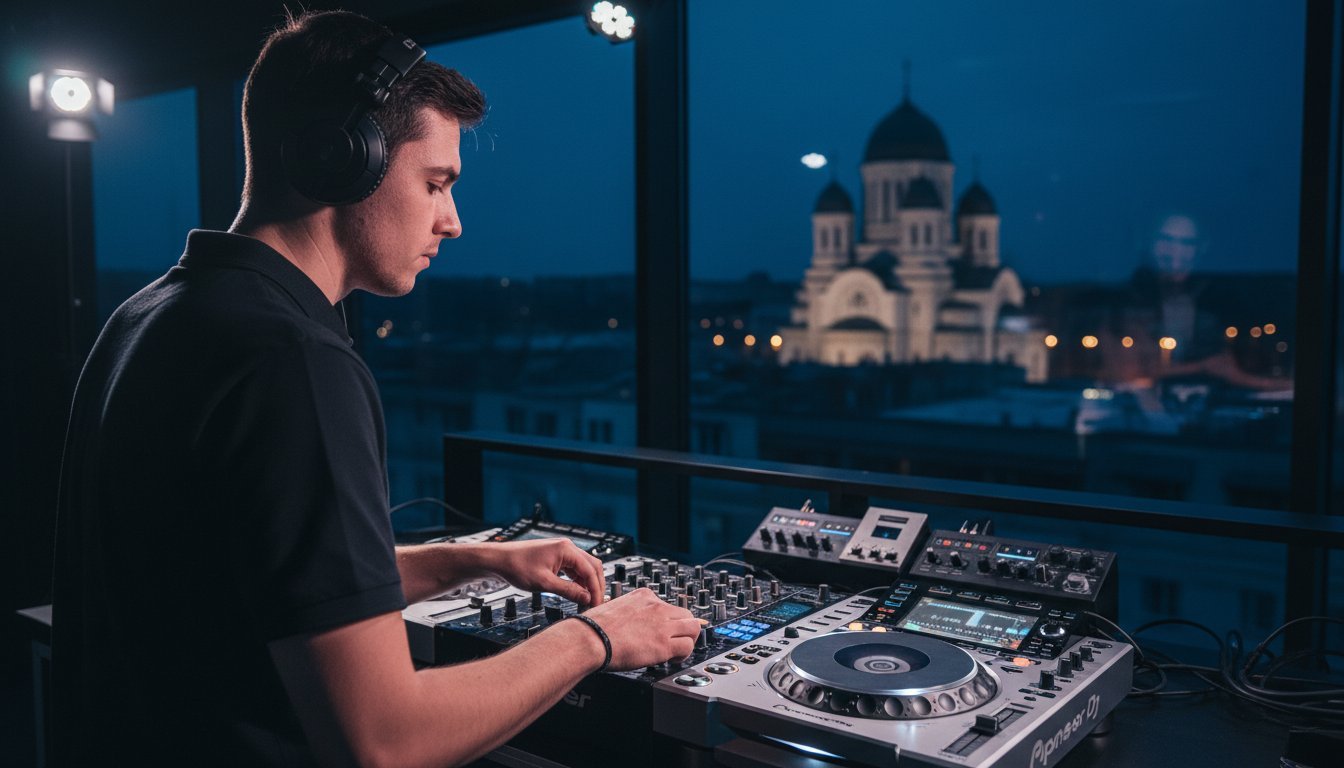
There’s a massive tactile difference between a plastic controller and the AlphaTheta hardware found in the world’s top clubs. Learning on a controller can actually hold you back. The pitch faders are shorter, the jog wheels have less resistance, and the buttons feel different. Our studio features CDJ-3000s and professional mixers that respond exactly like the gear you’ll find at major festivals. Mastering the resistance of a real jog wheel ensures your nudges are precise and your transitions are flawless. 🎧 Feel the gear. 🚀 Own the stage.
Book Your Session and Start Your Journey
We make it easy to start your professional journey with flexible hourly studio access and session packages. Whether you’re recording a 4K video promo set or just sharpening your ears with this beatmatching guide, we have the tools you need. Before you arrive, ensure your music library is pre-scanned in Rekordbox and loaded onto a high-speed 32GB USB stick. This preparation allows you to plug in and start mixing immediately. Check out our Gallery to see the setups waiting for you. Ready to join the Timișoara DJ community? Head to our Book Now Section to secure your booth. 🎧 Book now. 🚀 Bring your passion to life.
Take Control of Your Sound and Own the Booth
You now have the technical blueprint to move beyond the sync button and master the art of manual mixing. This beatmatching guide has shown you how to align tempos by ear, use the pitch fader with surgical precision, and sharpen your instincts through high-intensity drills. Professional credibility isn’t just about the tracks you play; it’s about the confidence you project when the screens fail and the crowd is waiting for the next drop. You’ve learned the mechanics, now it’s time to build the muscle memory.
Book a DJ Studio is the only pro practice space in Timișoara where you can train on the industry-standard Pioneer CDJ-3000 and Xone:96 setup. Capture your progress with our 4K video and audio recording add-ons to create the promo sets that get you booked. Don’t let your talent stay trapped in your bedroom. Book your pro practice session in Timișoara now! Your favorite mixer is waiting, and the stage is ready for you. Bring your passion to life and become the artist you were meant to be.
Frequently Asked Questions
Is beatmatching still necessary in 2026 with modern DJ software?
Yes, manual beatmatching is vital for any professional who wants to play on big stages. While 41% of DJs love streaming and AI features, software analysis still fails on tracks with live drums or complex rhythms. Knowing how to match by ear ensures you aren’t helpless when the sync button misses the mark or the grid is off. 🎧 Master the craft. 🚀 Own the booth.
How long does it typically take to learn beatmatching by ear?
Expect to spend 20 to 40 hours of focused practice to understand the basic mechanics. Reaching the stage of pure muscle memory usually takes several months of consistent weekly sessions. Using this beatmatching guide alongside professional gear speeds up the process by providing the tactile feedback you can’t get from a mouse or a touch screen. 🎧 Practice daily. 🚀 See the results.
Can I learn beatmatching on a cheap DJ controller?
You can learn the basic theory, but budget controllers often have short pitch faders that lack precision. Mastering the tiny 0.05% adjustments needed for a perfect mix is much harder on entry-level gear. Transitioning to club-standard hardware is essential if you want to play professional gigs without feeling lost in the booth. 🎧 Upgrade your skills. 🚀 Command the room.
What is the “Sync” button and when should I actually use it?
The Sync button automatically matches the BPM and phase of your tracks. It’s a powerful performance tool when you’re managing 4-deck mixes or using real-time stem separation to create mashups. Use it to free up your hands for creative effects, but never rely on it as a substitute for your ears. 🎧 Use the tools. 🚀 Keep the control.
What happens if I can’t tell which track is faster or slower?
Use the “nudge” method to test the alignment. Give the jog wheel a small push forward; if the mix sounds cleaner, your track was too slow. If it sounds worse, pull it back immediately. This trial and error is how you train your brain to recognize drift before the crowd does. 🎧 Trust your ears. 🚀 Fix the drift.
Is it harder to beatmatch on vinyl versus digital players?
Vinyl is significantly more difficult because you have no BPM displays or visual waveforms to guide you. You rely 100% on your ears and physical touch on the record. Mastering vinyl earns massive respect in the DJ community and makes digital beatmatching feel like second nature. 🎧 Respect the roots. 🚀 Level up.
How do I beatmatch tracks with different BPMs?
Use the pitch fader to bring the incoming track within a 1% or 2% range of the master track. If you’re jumping from 124 BPM Techno to 128 BPM House, you might need to slowly move the master fader during the transition to bridge the gap. This keeps the energy flow feeling natural for the dancers. 🎧 Blend the genres. 🚀 Keep the energy.
Why is my mix sounding “muddy” even if the beats are matched?
Muddiness is usually caused by clashing low-end frequencies. Even if you follow every beatmatching guide perfectly, having two kick drums at full volume will create a messy sound. Use your EQ knobs to cut the bass on one track while you bring in the other to keep the mix crisp and professional. 🎧 Clean your sound. 🚀 Perfect the mix.