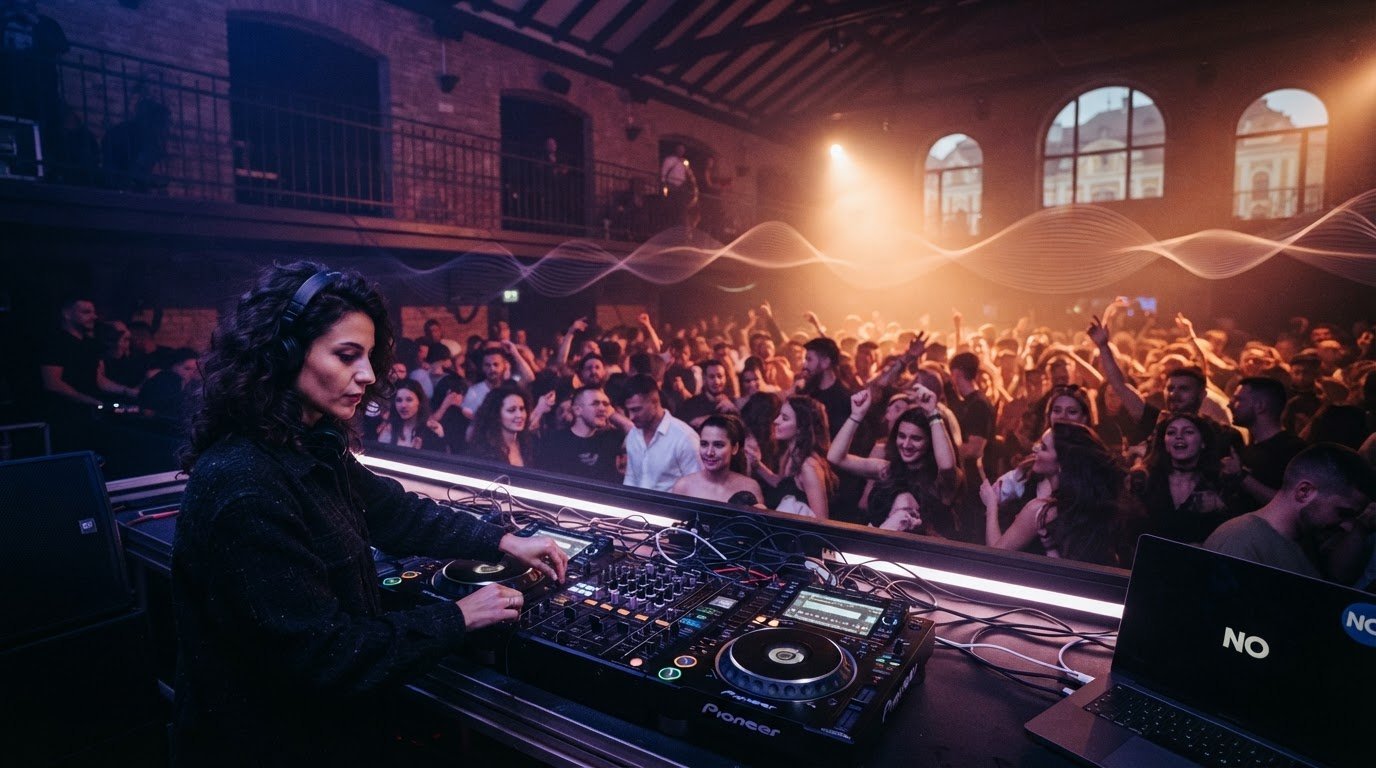

A DJ set becomes more than a run of tracks when you shape it into a story. Storytelling through a DJ set takes the crowd from an opening mood through rising tension to a satisfying release. The goal isn’t to play the biggest track as soon as possible, but to make every transition feel like part of the journey.
A strong set depends on reading the room and trusting your musical instincts. A narrative gives those instincts direction without locking you into a rigid playlist. Think in chapters, stay alert to the crowd’s energy, and leave room to respond in the moment.
This guide explores why narrative matters, how to shape a set’s opening, build, peak, and close, and how to choose tracks for their character and connections rather than relying only on genre or BPM. Turn your next session into a journey people can feel.
Key Takeaways
- Read the room before you commit to a musical direction, then adapt as the crowd responds.
- Use chapters to shape the mood and energy of your set while leaving room for spontaneous turns.
- Choose tracks for their character and how they connect in a mix, not just their genre or BPM.
- Give each part of your set a purpose so the transitions feel like movement through one unfolding story.
What is ‘Chapter’ DJing?
Chapter DJing divides a set into distinct sections, each with its own mood and purpose. Shape those sections around the room, then adjust the sequence as the audience responds.
Matching Tracks to Venue and Audience
Matching tracks to a venue and audience means choosing music that fits the room’s atmosphere, timing, and people. A bar set at 9pm may suit a different opening chapter from a club set at its 2am peak. Before playing, observe the crowd, venue, time, and surrounding energy. Those details help you choose a starting mood instead of forcing one fixed sound onto every room.
Give each chapter a clear musical role. In a relaxed bar, an opening might leave space for conversation, then introduce more rhythm as the room fills. A club set might begin with familiar grooves before moving into more intense selections. These are options, not rules: the setting informs the story, while your track choices give it character. The same record can land differently depending on when and where you play it.
Responding to Audience Reactions
Respond to the audience by using what you see and hear to shape the next chapter. Watch for people moving closer, dancing more freely, or turning away from the floor. Those signals can guide you to hold the current mood, raise the energy, or change direction. A prepared arc gives you a route, not a reason to ignore the crowd.
Make each adjustment purposeful. If a high-energy run loses the room, move into a warmer or more familiar selection before rebuilding momentum. If the crowd responds strongly to a particular rhythm, explore that feeling with the next track instead of switching styles abruptly. Keep an alternate chapter ready for shifts in energy. The plot, character, pacing, and setting of your set can all evolve with the audience.
Building a narrative through a DJ set
Shape your set like a journey, not a stack of tracks. Give each section a role, then control the pace so the energy rises with purpose.
Defining Set Storytelling
Storytelling through a DJ set means arranging tracks to create a progression of moods, tension, and release. That arc gives your choices direction, so the crowd experiences more than a series of individual tunes.
A set can open with a hook, deepen its mood, reach a peak, then wind down. There’s no fixed track count: it depends on track length, tempo, transitions, and how long each chapter needs to breathe. Build the sequence around the feeling you want each section to leave behind.
Pacing and Intensity
Pacing is how you space musical changes; intensity is how strongly they affect the room. Together, they keep a set from reaching its peak before the journey has gathered momentum.
Treat a 40- or 50-minute set as longer than it may feel, and resist rushing through its chapters. For practice, shape story-led sets lasting 30-90 minutes, with a clear goal for the start, peak, and close. For example, let a restrained opening make a later shift in energy feel earned, rather than jumping straight to your biggest track.
Common Storytelling Mistakes
Common mistakes include rushing the build, forcing a fixed sequence, and treating every transition as a climb. These choices can flatten the arc: when every track pushes harder, the peak loses contrast.
Leave room for a quieter passage, a held groove, or a deliberate change in direction. Another trap is choosing tracks just because they fit a planned slot, even when their mood clashes with the surrounding selections. Listen to transitions as part of the story, then adjust the order where the narrative breaks.
Test your arc from opening to close in a focused DJ practice session, and listen for where the energy needs more space.
Choosing tracks by personality rather than genre or BPM
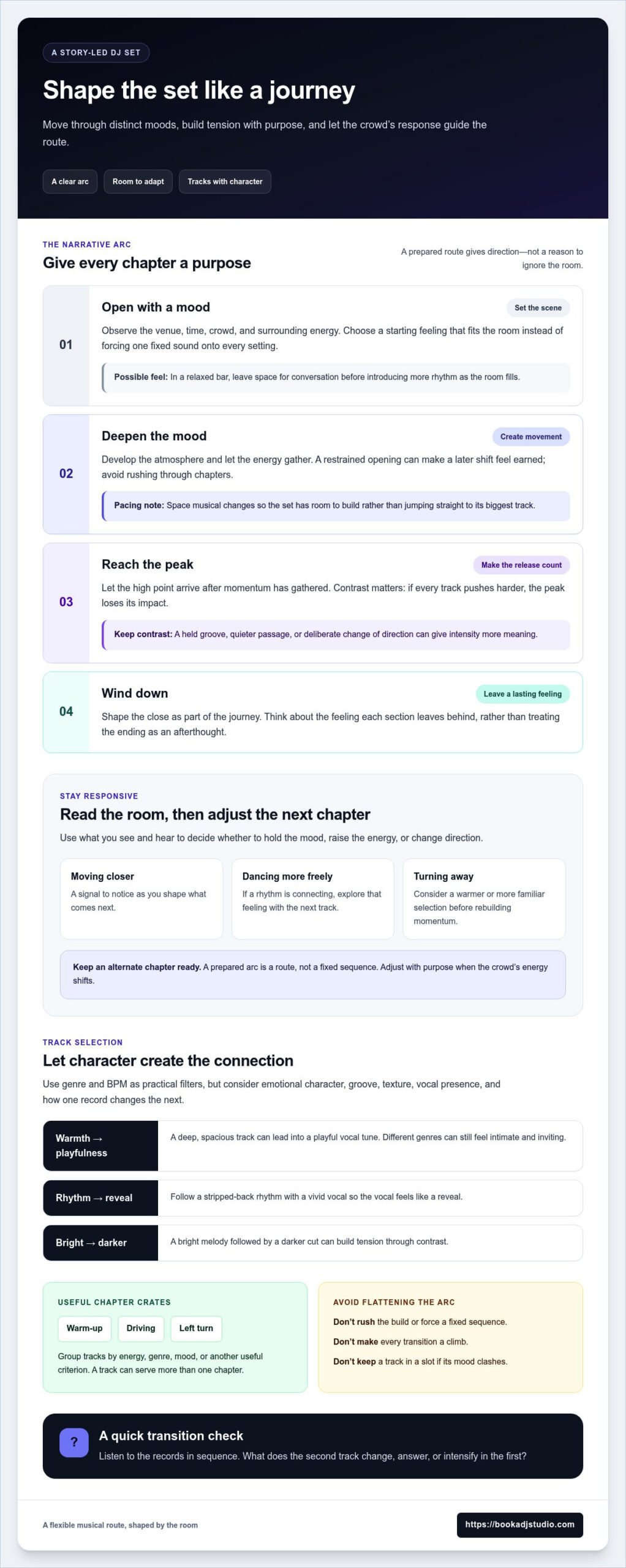
Let a track’s character guide your choices, then use genre and BPM as practical filters. The contrast between two records can create a more memorable connection than matching labels alone.
Choosing Tracks by Personality
Choosing by personality means noticing a track’s emotional character, such as warmth, tension, playfulness, or restraint. This helps you build a distinct mood instead of letting genre tags dictate every transition.
Picture a deep, spacious track followed by a playful vocal tune. They may differ in genre, yet both can feel intimate and inviting. Compare their groove, texture, vocal presence, and emotional weight. Use BPM to judge whether a mix is workable, but let character decide whether the tracks belong in the same moment.
Creating Meaning Through Track Combinations
Track combinations create meaning when their shared qualities or contrasts suggest a feeling beyond either record alone. That connection gives listeners a reason to experience the sequence as a story.
Pair a stripped-back rhythm with a track that introduces a vivid vocal, making the vocal feel like a reveal. Or follow a bright melody with a darker cut to build tension. Listen to the records in sequence, not just on their own. Ask what the second track changes, answers, or intensifies in the first.
Organizing Tracks into Chapters
Organizing tracks into chapters means grouping selections by energy, genre, mood, or another useful criterion. Clear groups ease decision-making while keeping your options open during a set.
Create crates such as “warm-up,” “driving,” and “left turn,” then place tracks where their character fits. A tune can belong in more than one chapter if it serves different roles. AI recommendations can help surface possible connections in your library, but treat them as prompts. Preview each pairing yourself: software can suggest matches, while your ears decide the story.
To reduce selection stress, narrow your live choices to tracks that support the current chapter. When building a restrained opening, for example, browse that crate first instead of scanning your entire library. Keep a contrasting option nearby for a purposeful shift. This simple boundary speeds up decisions without locking you into a fixed playlist.
Why narrative storytelling matters in DJ sets
Famous storytelling sets include Flying Lotus’s opening at Le Poisson Rouge in New York City at 12am, where ambient synths and faded percussion created a gradual entrance. At London’s The End, Jeff Mills played a full ten-minute version of Dan Hartman’s “Relight My Fire” after about an hour and a half. Around a hundred people gathered near his booth, listening rather than dancing.
These moments show how a set can hold attention without relying on constant peak energy. Flying Lotus used atmosphere to draw listeners into the performance; Mills let one extended track become an event. In both cases, the musical choice shaped the crowd’s experience. A narrative gives your decisions a through-line, so a softer passage or unexpected selection feels intentional rather than random.
That through-line also makes your artistic identity easier to hear. Imagine opening with hazy textures, introducing sharper percussion, then resolving the tension with a familiar vocal. The contrast gives listeners landmarks to follow. They may remember not just an individual track, but the shift from anticipation to release. That emotional movement makes a set feel authored, not merely assembled.
Apply the same principle to visuals. Choose images that complement the music or reflect its mood, rather than adding unrelated motion. If a set moves from spacious ambience into dense, driving rhythms, visuals can echo the transition. Keep the music’s story in control. A striking screen effect should support the sound, not compete with your choices.
Build a set with one clear emotional idea, then test whether each transition strengthens it. Record a practice mix and listen for the moment your attention drifts or the mood changes without purpose. Refine that passage. Book a focused DJ studio session to shape and record your next narrative-driven mix.
Book a DJ Studio: Hourly Studio Access
Book a DJ Studio gives you a dedicated space to rehearse your narrative arc and refine transitions. Choose Hourly Studio Access for focused practice, or Session Packages for a longer-term routine. When your set is ready to share, Audio Recording and 4K Video Recording let you capture the performance.
Use a studio session to test how your chapters connect, listen back for pacing, and adjust before performing for an audience. It’s a practical next step when your track selection feels strong but the complete set needs a focused run-through.
Contact Book a DJ Studio to explore a session for your next mix.
Shape the Set Only You Can Play
Make your next mix a creative experiment, not a test with one right answer. Choose an emotion to explore, then let that intention guide your decisions in the booth. It might be anticipation, euphoria, nostalgia, or tension that never fully resolves. Your point of view turns familiar sounds into a set that feels unmistakably yours.
Let storytelling through a DJ set become a practice of discovery. After each run-through, note one moment that felt alive and one that felt disconnected. Change a single choice, then listen again. Small, deliberate edits help you develop a signature without sanding away the spontaneous instincts that make live mixing exciting.
Ready to give your next idea room to grow? Contact Book a DJ Studio and take the next step with your mix. Bring your curiosity, trust your ears, and build a set that carries your own creative pulse.
Frequently Asked Questions
WHY TELL STORIES?
A musical storyline gives your choices a recognizable point of view. It helps listeners connect contrasting tracks instead of hearing them as isolated selections. For example, bringing back a distinctive vocal texture later in a mix can create a sense of recognition. Use that thread to make your set feel personal and give your musical decisions clear purpose.
How do DJs structure a set to tell a story?
Choose an emotional premise, then mark a few possible turning points in your playlist. A set built around anticipation might begin with sparse textures, introduce a recurring motif, then bring it back in a fuller arrangement. Keep alternate tracks nearby. This gives you a map to perform from, not a fixed sequence that limits your response to the room.
How do tempo, key, and energy shape a DJ set narrative?
Tempo affects movement, key can guide harmonic compatibility, and energy describes a track’s perceived intensity. Consider all three, but don’t assume they must rise together. A steady tempo can still feel more forceful with denser percussion, while a harmonic shift can change the mood without changing the groove. Listen to the transition in context before committing.
How can track selection and transitions create a coherent journey?
Look for a connection between tracks, such as a shared vocal tone, rhythmic pattern, or mood. Then make that relationship audible in the transition. A gradual blend can reveal similarities; a clean cut can spotlight contrast. Preview the outgoing and incoming sections together, and decide what the second track adds to the moment instead of selecting it in isolation.
How do DJs build tension, release, and emotional arcs in a set?
Build tension by withholding a musical payoff. You might keep a groove steady, strip back an arrangement, or repeat a vocal phrase before bringing in a fuller sound. Release can come from restoring the bass or resolving the phrase with a new track. Use contrast: a quieter passage makes the next surge more distinct than another uninterrupted run of peaks.
What equipment and software help DJs plan a narrative set?
DJ software helps you prepare playlists, while players and a mixer let you rehearse transitions. Book a DJ Studio in Timișoara has two Pioneer CDJ-3000X players and a Pioneer DJM V-10 mixer. Bring headphones and music on a USB stick with a maximum size of 32 GB. Scan the music in Rekordbox, then export it to the stick before your session.