

Using Sync isn’t cheating. It’s a tool, but check the beat alignment by ear and practise manual beatmatching so you stay in control when tempo readings or beat grids are off. Many common DJ mistakes and how to fix them come down to relying on the screen instead of listening, planning, and reading the room.
A set can lose its spark when transitions feel rushed or the energy doesn’t connect. The answer isn’t piling on effects or chasing perfect waveforms. Build your instincts: organize tracks by BPM, key, and energy, leave space between vocals, and use effects to lift a transition rather than hide it. This guide covers habits that disrupt track flow and how to improve them, from phrase counting and bass swaps to reading the crowd and shaping the room’s energy. Practise the craft behind the decks, then let your presence carry the set.
Key Takeaways
- Read the room before raising the energy, and let the crowd’s response shape your next track choice.
- Use effects to accent a transition, not cover up timing or phrasing that needs work.
- Give vocals room to breathe by choosing instrumental sections for your blends and keeping the mix clear.
- Build stage presence through confident, purposeful interaction that keeps your attention on the audience and the music.
- Record a practice set and listen back to catch flow issues you may miss while mixing.
1. Organizing music by BPM, key, and energy
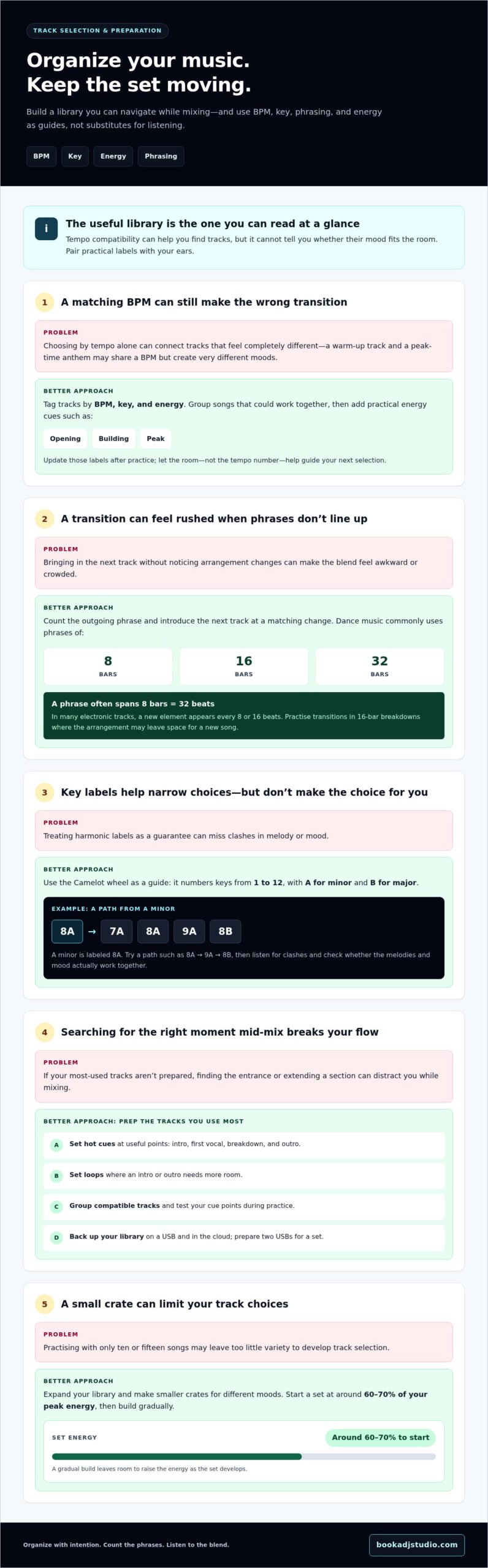
Build a library you can navigate while mixing. Tag tracks by BPM, key, and energy, then group songs that could work together. BPM helps you find compatible tempos, but it can’t tell you whether a transition suits the room. A warm-up track and a peak-time anthem may share a tempo but create very different moods. Label tracks with practical cues such as “opening,” “building,” or “peak,” and update those labels after practice.
Use phrasing to find a natural entrance. Dance music commonly uses phrases of 8, 16, or 32 bars, and a phrase often spans 8 bars, or 32 beats. In many electronic tracks, a new element appears every 8 or 16 beats. Count the outgoing phrase, then bring in the next track at a matching change. Practise transitions in 16-bar breakdowns, where the arrangement may leave space for a new song.
Let key labels guide your choices, not make them for you. The Camelot wheel assigns each key a number from 1 to 12, with A for minor and B for major. A minor is labeled 8A, which can blend with 7A, 8A, 9A, or 8B. Try a path from 8A to 9A to 8B, then listen for clashes. Beatmatch by ear and check whether the melodies and mood actually work together.
Prepare your most-used tracks before a set. Add hot cues to useful points, such as the intro, first vocal, breakdown, and outro. Set loops where an intro or outro needs more room. Keep a USB backup and a cloud backup of your library, and prepare two USBs for a set. Group compatible tracks and test your cue points during practice, so you’re not searching for the right moment mid-mix.
A beginner practising with only ten or fifteen songs may have too little variety to develop track selection. Expand your library and build smaller crates for different moods. Start a set at around 60–70% of your peak energy, then build gradually. Protect your hearing during practice, too. According to the National Institute for Occupational Safety and Health (NIOSH), recommended exposure time halves for every 3 dBA increase in sound level. Lower the volume when needed, and keep your listening sharp.
2. What is the most common beginner DJ mistake?
A common beginner DJ mistake is focusing more on technical perfection than on reading the room. Even a precise blend can fall flat if its energy doesn’t match what people are responding to.
Common gig etiquette mistakes include running past your set time, touching another DJ’s controls without permission, or disrupting a handover. Don’t assume that owning or accessing a track automatically covers its public performance. Clarify who handles permissions for the event before playing, and follow the organizer’s arrangements.
Start with observation. Spend the first 10 minutes noticing how people respond before pushing the energy higher. Watch for dancers staying on the floor, groups joining in, or people drifting toward the edges. One person’s reaction doesn’t define the whole room, so look for patterns across several tracks. Your job isn’t to guess every listener’s taste. It’s to choose music that suits the room’s current mood.
Shape the set through small, considered moves. If people respond to a familiar groove, try a related track with more drive. If dancers leave after a sharp change, return to a sound that held their attention. Let each selection play long enough to register. A beginner DJ who changes tracks after every glance may mistake ordinary movement for rejection.
Look up from the screen between technical adjustments. Check your mixer and waveforms when needed, then use the next musical passage to observe the crowd. A busy breakdown can look exciting on screen while the room loses momentum. Let people’s movement guide your next choice. Many common DJ mistakes begin with treating screen activity as a substitute for reading real reactions.
Turn crowd-reading into a practice routine. Observe, choose a track, then assess what changed. Focus on one cue, such as whether people stay through a vocal or respond to a stronger kick. After the selection, decide whether the energy rose, held, or dipped. This makes reading the crowd an active skill rather than a vague instinct. A filter or familiar groove can support the mood, but neither replaces noticing the room.
Keep your setup steady while you make those choices. If you’re staring at the display to correct every small detail, rehearse until routine controls feel familiar. Record a practice mix and note where your track choices ignore the room’s imagined response. A useful way to approach common DJ mistakes and how to fix them is to review one decision at a time. A focused DJ practice session gives you room to build that awareness without rushing your next move.
3. Using effects sparingly
Effects can add movement to a transition, but constant processing can distract from the track. Before touching a knob, decide what you want the effect to do: build tension, extend a phrase, or soften an exit. For example, a brief echo on the outgoing vocal can create space for the next instrumental intro. If you can’t name its purpose, leave the effect off. Knowing when not to add another layer is part of developing control behind the decks.
Start with a clean mix, then add colour only if it helps. Set the phrase and levels first, then try one effect at a time. A filter sweep can create a gradual handoff between tracks, while a short echo can trail a final vocal word. Keep the effect controlled, and return the knob to its neutral position after the transition. That reset prevents an accidental wash from carrying into the next track.
Use effects to enhance a transition, not conceal one. If two tracks drift out of time, reverb won’t fix their timing. If the incoming track enters during a crowded vocal, a filter won’t clarify the arrangement. Pause the effect, fix the blend, and listen to the phrasing. Clean transitions, tight EQ, and confident timing come first; effects work best once those fundamentals are solid.
Give intros room to establish their groove. A long reverb tail or repeated delay over the incoming intro can blur its first kick and make the mix feel distant. Keep the intro clear, then add a subtle effect at a deliberate point, such as the last beat before a breakdown. Compare dry and processed versions during practice, and choose the one that supports the track’s character.
A common DJ mistake is stacking effects because each one sounds exciting on its own. Echo, flanger, and filter together can smear transients and turn a focused transition into noise. Pick one effect and make a small adjustment while listening through headphones and speakers. If the kick loses definition or the melody becomes hard to follow, reduce the effect or switch it off. The crowd needs the musical change, not a display of every control.
Make each effect a short, intentional gesture. For example, use a brief echo to mark an outro, then let the next track play cleanly. Record a practice mix and note where effects improve the handoff and where they distract. If the same transition works without processing, keep it dry. This is one practical way to fix common DJ mistakes: give your strongest effect moments contrast, so they land with purpose instead of becoming constant background decoration.
4. Avoiding clashes between vocals and other elements
Two lead vocals playing at once can turn a smooth transition into a muddle. Bring in the next vocal during an instrumental section, or wait until the outgoing singer finishes a phrase. Listen to both tracks in your headphones before opening the incoming channel. If each voice is fighting for attention, delay the blend or choose a different entry point.
Protect the low end while making space. Keep one bassline driving the mix at a time: lower the incoming track’s bass during its introduction, then swap bass levels at the start of a new phrase. Use the channel EQ to reduce crowded mids when vocals overlap briefly. Don’t cut every frequency at once; preserve the incoming track’s character and restore the EQ smoothly after the transition.
Gain staging matters as much as phrasing. Set each channel gain while its track is playing, and keep the level meters in the green-to-yellow range. Avoid redlining, because levels pushed into the red can clip and distort. Check the master output as well as individual channels; a clean channel can still contribute to an overloaded master. Do a soundcheck to find levels that keep the signal clear.
To beatmatch accurately and avoid tempo drift, match the tracks’ tempos, then listen to their kick drums and adjust the jog wheel or pitch control when the beats separate. Even with Sync enabled, check alignment by ear before mixing in. Waveforms and beat grids can guide you, but your ears catch timing shifts the display may miss.
If feedback or monitor problems arise during a performance, lower the relevant channel or monitor level first, then identify which signal changes the noise. Check cable connections and signal routing, and make one adjustment at a time. For an uneven sound system, compare your booth monitor with the room sound and adjust gain without pushing the master into red. A quick soundcheck can reveal level problems before the set begins.
Don’t treat every rough transition as a reason to buy new gear. Learn the mixer, controller, and monitoring setup you already use; practise gain, EQ, and phrasing until you can identify the source of the problem. Some beginner DJ mistakes come from ignoring the signal path and reaching for an upgrade too soon. Record a practice mix and check the exact control names in your equipment manual when a feature is unclear. Good diagnosis beats impulse purchases, and clear levels let every vocal and kick land with intent.
5. Stage presence and audience connection
Strong stage presence isn’t constant movement behind the decks. It’s making intentional choices while staying connected to the people in front of you. A common beginner DJ mistake is looking down throughout every track, even after the mix is stable. Keep your eyes on the room between technical adjustments, and notice whether people are moving, talking, or leaving the floor.
Give your attention a rhythm. Before a transition, check your channel levels and cue the next track. Once the blend is smooth, look up and read the room instead of watching every waveform. During a breakdown, use the quieter moment to observe the crowd’s response. Then decide whether the next selection should maintain the mood or shift its energy.
Let your body language support the music. Stand confidently, move naturally with the beat, and avoid gestures that distract from the set. A raised hand can emphasize a familiar hook, but repeating the same gesture through every track makes it feel automatic. Match your movement to the moment, then return your focus to the mix when beatmatching or adjusting a control needs your attention.
Connection comes through selection, not just performance. If dancers respond to a particular groove, follow that signal with a related track instead of making an abrupt jump to a different mood. If the room grows quieter, let a musical moment breathe before pushing the energy again. Your role is to guide the set while staying alert to people’s responses, not to force a reaction from every track.
Practise presence as deliberately as transitions. Record a full practice set, then review the audio for pacing and smooth transitions. If you can record video, watch whether you stay focused on the screen, turn away from the room, or move naturally during musical moments. Choose one habit to improve in your next run. This gives you a clear target instead of trying to change everything at once.
Try a simple rehearsal: mix two tracks, check your levels, then look away from the display until the next cue needs attention. Keep your hands relaxed and your posture open. Review the recording afterward and note where your attention shifts away from the performance. To build stage confidence through recorded practice, record and review a DJ set. Make the room part of your mix, and let your presence reinforce the music rather than compete with it.
Book a DJ Studio: Hourly Studio Access
Book a DJ Studio gives you a dedicated space to practise transitions, build stage confidence, and refine your set with Hourly Studio Access. Choose Session Packages for repeat practice, or add Audio Recording to hear where your timing, levels, and track flow need work. 4K Video Recording lets you review your presence behind the decks and spot habits you may miss while mixing.
Put your next set through its paces in a focused studio session. Visit Book a DJ Studio to explore your options or get in touch.
Make Your Next Set Your Own
Every set gives you a fresh chance to turn preparation into instinct. Choose one detail to focus on at your next practice: a more confident entrance, a calmer transition, or a moment of connection with the room. Small, deliberate adjustments help your style emerge without making the performance feel overplanned.
Treat common DJ mistakes and how to fix them as a starting point, not a checklist you have to follow perfectly. Trust your ears, stay present, and give yourself room to experiment. Your strongest sets grow from choices that feel true to you.
Plan your next DJ practice session and keep building toward the sound and presence you want to bring to every set.
Frequently Asked Questions
Is using the sync button cheating?
No. Sync is a performance tool, not a measure of whether you’re a real DJ. Use it to keep a set moving, especially when you’re managing track selection or audience interaction, but understand what the software is doing. For practice, try mixing a pair of tracks with Sync, then repeat the blend manually. You’ll build confidence with either approach when a beat grid needs correction.
What is the most common beginner DJ mistake?
A common beginner mistake is treating a prepared set as a fixed script. A sequence that works in rehearsal may not fit the room, so prepare alternate tracks for different moods. For example, keep a familiar, lower-energy option ready if a big track doesn’t connect. This helps you adapt without scrambling through your entire library or abandoning your musical direction.
How do I stop playing for myself instead of the crowd?
Choose each track in response to something you can observe, not only your personal favourites. Before selecting the next song, name one cue from the room: dancers joining in, people leaving, or the floor holding steady. Then choose a track that answers that cue. After each practice set, make a short note about where your selections followed your own taste rather than the crowd’s response.
How many effects should a DJ use?
There’s no fixed number that suits every set. Choose an effect only when it serves a clear musical purpose, such as marking an exit or creating a brief rise in tension. If a dry transition already sounds strong, leave it untouched. During practice, record two versions of the same blend, with and without the effect, then listen for which keeps the groove and detail clearer.
Why do my DJ mixes sound muddy?
Muddy mixes often come from too many sounds competing at once, especially sustained bass, dense mids, or overlapping vocal phrases. Listen to the blend through headphones and identify which element loses definition. Try reducing one channel’s competing frequency range rather than turning down the whole mix. Also check whether effects or excessive channel gain are adding buildup. A cleaner arrangement often comes from removing a layer, not adding more processing.
Why do my DJ transitions sound bad?
A transition can feel awkward when tracks have different phrase lengths, energy, or rhythmic emphasis. Listen to the outgoing track’s arrangement and choose an entrance where its main element won’t collide with the incoming song. If the blend still feels forced, shorten it and use a clear handoff instead. Record the result, then note whether timing, track choice, or level balance caused the rough moment.
How can DJs choose compatible tracks and avoid clashing keys or energy levels?
Compare the musical mood, arrangement, and intensity before relying on key labels alone. Two tracks with compatible keys can still feel mismatched if one has a sparse intro and the other opens with a dense vocal hook. Preview the incoming section in headphones, then ask whether its melody and energy suit the moment. Keep alternate choices ready, so a technically compatible song isn’t your only option.
What causes bad transitions in DJ sets, and how can they be fixed?
Bad transitions can stem from rushed entrances, mismatched arrangements, drifting beats, or abrupt level changes. Diagnose the issue by replaying the blend and listening for the first moment it stops feeling musical. Then change one thing: move the cue point, reduce the overlap, or adjust the channel level. Fixing one cause at a time makes practice more useful than repeating the same blend without a clear adjustment.