

Your route depends first on your citizenship. Getting your first residency in Timisoara means registering for a residence certificate if you’re an EU, EEA or Swiss citizen, while non-EU, EEA and Swiss nationals intending to stay in Romania for more than 90 days need a residence permit. The right process starts with knowing which category applies to you.
It’s easy to assume everyone follows the same application path, but requirements and paperwork differ. Get the essentials straight before you make plans around a job offer or a new address.
This guide explains residence requirements for EU, EEA and Swiss citizens, outlines documents for an employment residence permit, and covers what to expect from the application process. Identify your route, organize your paperwork, and take your next step in Timișoara with confidence.
Key Takeaways
- Understand what shapes residence-permit processing time and how the permit’s validity depends on its purpose.
- Spot common application issues early and learn what steps may follow a refusal.
- Use the relevant eligibility route to organize your residence application and supporting documents.
- Keep your creative momentum in Timișoara with Hourly Studio Access, Session Packages, or session recording.
How long does it take to receive a first residence permit in Romania, and how long is it valid?
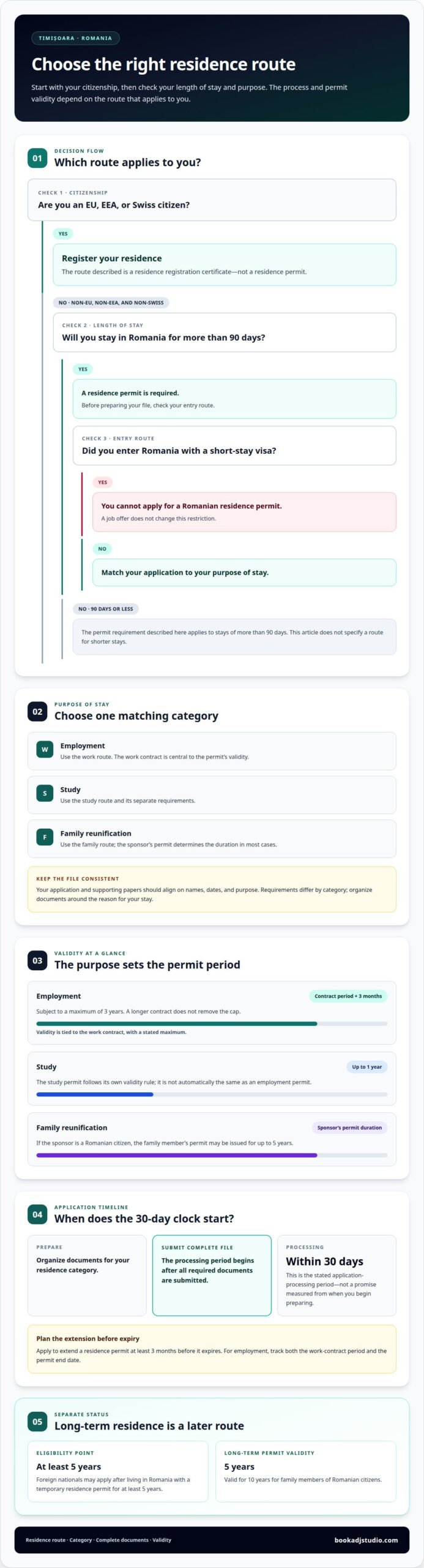
A residence permit is the document that authorizes a qualifying non-EU, non-EEA, or non-Swiss citizen to reside in Romania. If you intend to stay for more than 90 days, you need a permit matching your purpose of stay, such as employment, study, or family reunification.
The processing period is the time taken to assess an application after the required documents have been submitted. In Romania, applications are processed within 30 days after submission of all required documents. The 30-day period does not start when you begin preparing your file. It begins after the required documents have been submitted.
A complete application is an important practical step. Before submitting, organize your documents around the reason for your stay. An employment application, for example, follows the work route, while a student application follows the study route. The required documents depend on your purpose.
Processing time and application status
Allow for the stated processing period after the relevant authorities receive your complete application. A file missing a required document may not meet the starting condition: submission of all required documents. Keep the process on track by organizing the paperwork for your residence category before filing.
The 30-day period describes application processing. It is not a stated promise that every applicant will hold a permit exactly 30 days after first considering a move. The key reference point is when all required documents have been submitted. Plan around that step, rather than treating preparation time as part of the processing period.
Also separate residence registration from a residence permit. EU, EEA, and Swiss citizens registering their residence in Romania receive a registration certificate rather than applying for a residence permit. The 30-day permit-processing rule therefore concerns permit applications, not that registration certificate process.
How long the permit is valid
A permit’s validity is the period during which it authorizes you to live in Romania. Its duration depends on the residence category, with different rules for employment, study, and family reunification.
- Employment: An employment residence permit is issued for the work-contract period plus three months. The permit’s validity is subject to the rules for its category.
- Study: A study residence permit may be granted for up to one year. Its validity is not automatically the same as the employment-permit period.
- Family reunification: The permit lasts for the same duration as the sponsor’s permit. When the sponsor is a Romanian citizen, it may be issued for up to five years.
For an employment application, the contract period is central to calculating validity. The permit adds three months to that period, subject to a maximum of three years. A longer contract does not remove the cap, and a shorter contract does not make the permit valid for the maximum by default.
For study, the stated maximum is one year. For family reunification, the sponsor’s permit determines the duration, except when the sponsor is a Romanian citizen: a family member’s permit may then be issued for up to five years. These categories follow different rules, so choose the one that matches your stay.
Long-term residence is a separate status from a first temporary permit. According to the Romanian General Inspectorate for Immigration, foreign nationals may apply for long-term residence after living in Romania with a temporary residence permit for at least five years. A long-term residence permit is valid for five years, or ten years for family members of Romanian citizens.
Keep expiry dates on your timeline. In Romania, you must apply to extend a residence permit at least three months before it expires. For an employment permit, note both the work-contract period and the permit’s end date. For other categories, track the validity period shown on your permit and begin the extension process within the required timeframe.
What are common reasons Romanian residence permit applications are rejected, and can a refusal be appealed?
An eligibility mismatch occurs when your application route does not fit your citizenship or purpose. First establish whether you are an EU, EEA, or Swiss citizen, or a non-EU, non-EEA, and non-Swiss national. Then match your reason for residence to the relevant procedure. This helps prevent a category error before you assemble your documents.
One clear mismatch involves entry with a short-stay visa. Non-EU, non-EEA, and non-Swiss nationals who enter Romania with a short-stay visa cannot apply for a Romanian residence permit. A job offer does not change this restriction. If this describes your entry route, an employment application will not resolve the visa issue.
Citizenship category matters. EU, EEA, and Swiss citizens registering residence in Romania receive a registration certificate rather than applying for a residence permit. Using the permit route when registration applies may create avoidable confusion. For example, an EU citizen moving to Timișoara for work should follow the registration procedure, not assume the non-EU employment-permit process applies.
A purpose mismatch occurs when your stated reason for residence does not fit the route you choose. Employment, study, and family reunification are separate categories with distinct requirements. Before preparing your file, identify the purpose that accurately describes your stay. Keep the application and supporting documents focused on it instead of combining explanations for unrelated categories.
Document inconsistency means details in your application and supporting papers do not align. Names, dates, and the stated purpose should tell a coherent story. In an employment case, for example, the employment basis should be clear throughout the file. Papers that appear to support another category can cause confusion unless their relevance is clear.
These examples describe practical preparation risks, not a complete official list of refusal grounds. A decision depends on the application and its legal basis. Use this sequence to reduce avoidable errors:
- Identify your citizenship category before choosing a procedure.
- Confirm that your entry route permits the application you intend to make.
- State one accurate residence purpose and keep the file consistent with it.
- Read every written request or decision from the Romanian authorities carefully.
A refusal is a formal decision declining an application. Whether and how you can appeal depends on the written decision and applicable Romanian procedure. Start with the notice: identify its stated grounds, appeal instructions, and any deadline. Do not assume that submitting a new application is the same as appealing the refusal.
If the notice does not make the next step clear, seek advice promptly from a qualified Romanian immigration lawyer. Provide the full refusal decision and the application you submitted so the advice addresses the actual grounds. Focus on what the authorities wrote rather than guessing why the file failed or relying on a general checklist.
If you’re getting your first residency in Timișoara, keep the process simple: establish your citizenship category, choose the matching procedure, and prepare a consistent file. A clear plan for getting your first residency in Timișoara also means treating a refusal notice as the starting point for understanding the decision, not as a reason to repeat the same application unchanged.
For study applications, omissions from the required supporting material can create a practical risk. Applicants must provide proof of financial means of at least the minimum gross salary. Non-EU/EEA/Swiss student applicants are asked to provide a certified copy of the Letter of Acceptance to studies issued by the Romanian Ministry of Education, Research, Youth and Sports, together with health insurance for the entire period covered by the residence permit. Check the current student application fee before submitting your application.
A long-term student residence permit may be granted on request to foreign students who wish to enter Romania. If you’re seeking long-term residence, track your time outside the country as well as your residence period: during the five-year qualifying period for Romanian long-term residence, you cannot have been outside Romania for longer than six months. Check that your application materials address the relevant requirements and contain consistent information. If your application is refused, the written decision can clarify which requirement the authorities say was not met. Assess the stated reason before deciding how to respond.
Book a DJ Studio
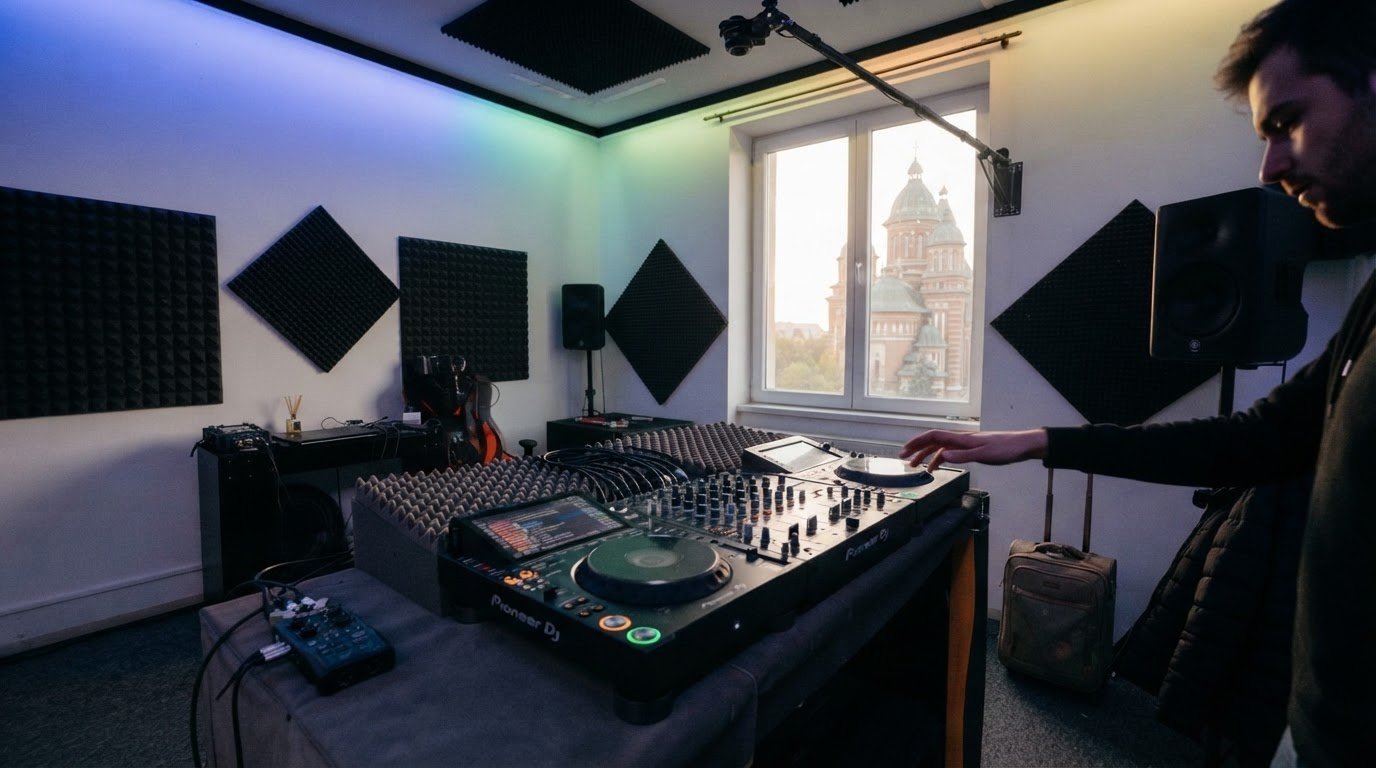
Book a DJ Studio gives you a creative space to keep practicing as you settle into Timișoara. Once your residence paperwork is underway, book Hourly Studio Access for a focused practice session or choose Session Packages for repeated studio time. Build your sound, refine your transitions, and prepare a set at your own pace.
Ready to capture a performance? Audio Recording and 4K Video Recording can help you create material for sharing and promotion. These studio options support your music journey; they don’t replace immigration advice or help with residence applications. Keep your next steps clear, on the decks and with your paperwork.
Contact Book a DJ Studio to plan your studio session.
Make Room for Your Next Chapter
Getting your first residency in Timișoara is one part of building a life in a new city. Keep important paperwork organized, make space for your creative work, and set small goals that help you feel at home. Progress doesn’t have to happen all at once. One focused session, one finished mix, or one new local connection can make the transition feel more like your own.
Your next step can be practical and creative. If you’re ready to turn an idea into a set or capture a performance, contact Book a DJ Studio to talk about your studio plans. Bring your sound, shape your next session, and keep building momentum in Timișoara. Your new chapter is yours to create.
Frequently Asked Questions
What health insurance, income, housing, or background-check requirements apply to Romanian residency?
Requirements for insurance, income, housing, and background records vary by Romanian residence category. Health insurance requirements for study applicants depend on their citizenship category and permit circumstances. Study applicants must show means of at least the minimum gross salary. EU/EEA/Swiss students declare funds for the full permit period, measured as the minimum net salary per month in the economy. Background-record documentation may be required for some student applicants. Housing proof varies by category.
How do you apply for your first Romanian residence permit through the Timiș County immigration office in Timișoara?
First identify your citizenship category and reason for staying, then prepare the documents required for that route and submit the complete application to the relevant authorities. Processing takes 30 days after all required documents are submitted.
Which documents are required for a first Romanian residence permit, and do they need translation or apostille?
Requirements depend on your purpose of stay. Student applicants may need to provide documents relating to admission, identity, insurance, finances, and background records. Translation or apostille requirements are not specified.