
What if confidence behind the decks comes from knowing how to play through nerves, not waiting for them to disappear? A missed cue can feel huge under the lights, but nerves alone don’t mean you’re unprepared. You can overcome dj performance anxiety by building confidence through focused, repeatable practice.
Learn what may fuel performance nerves and how to keep your attention on the music when pressure rises.
This guide covers practical ways to prepare, reset, and make rehearsal feel more familiar, including focused practice at Book a DJ Studio in Timișoara.
Key Takeaways
- Performance nerves don’t prove you lack talent or preparation. Notice when ordinary anticipatory nerves start affecting your set.
- When your focus slips, pause, breathe slowly, listen to the track, and choose one clear next action.
- To overcome dj performance anxiety, build confidence step by step: rehearse transitions, play a full set, then review what felt uncertain.
- Use a practice mix to spot patterns and track progress with curiosity instead of judging every mistake.
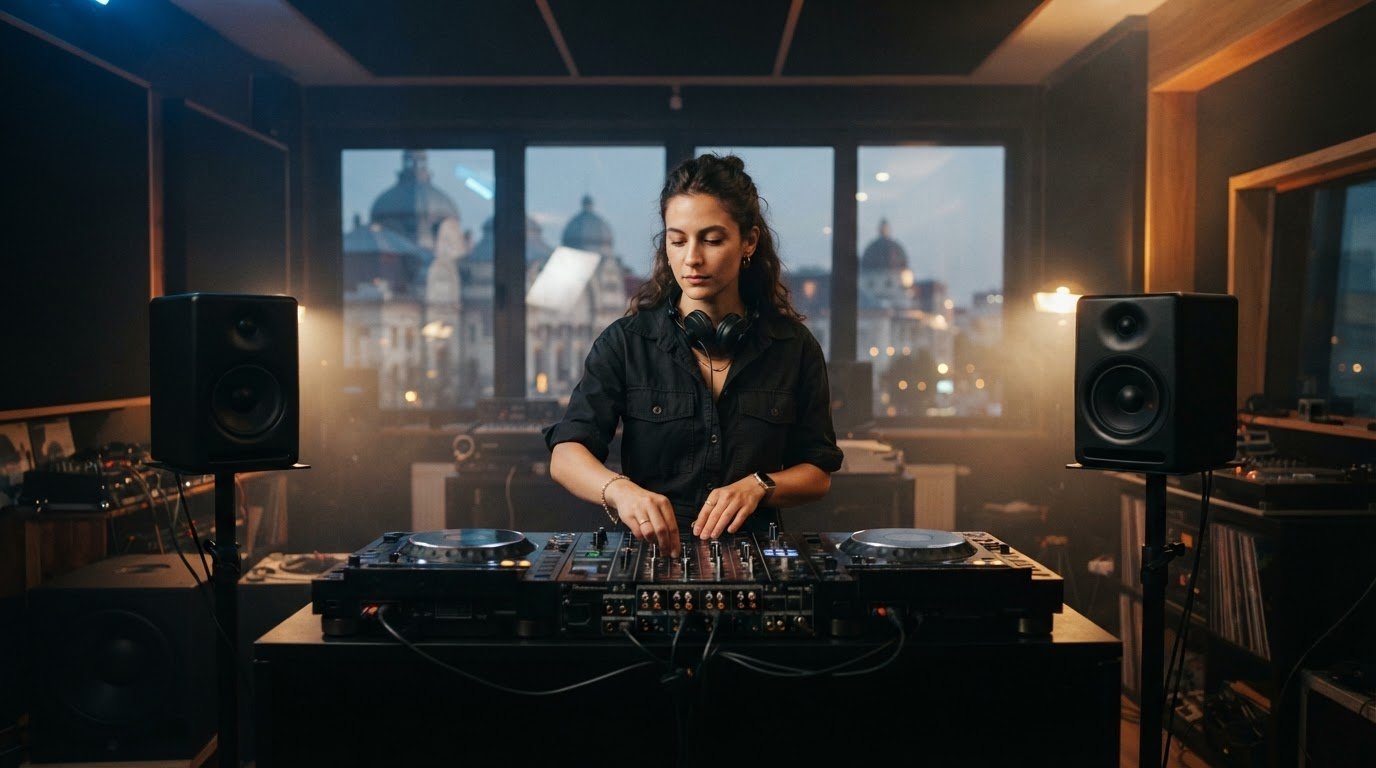
- In Timișoara, practise in a festival-style booth with 2 Pioneer CDJ-3000X players, a Pioneer DJM-V10 mixer, 2 Yamaha DXR12 MKII speakers, and a Yamaha DXS15 MKII subwoofer.
Why DJ performance anxiety happens, and what it does not mean
Nerves before a set are a common response to performing while people are paying attention. They don’t prove you lack talent, and they don’t automatically mean you haven’t prepared. Your body may simply be reacting to the pressure of being seen and heard. The useful move is to get curious about that response, rather than turning it into a verdict on your ability.
DJ performance anxiety is nervousness or fear linked to playing in front of an audience, especially when you worry about making a mistake or being judged. Feeling keyed up before a gig is not, by itself, a diagnosis or evidence that you can’t perform. Stage fright or performance anxiety describes the broader experience of fear around performing. If anxiety is persistent, distressing, or interfering with everyday life, a qualified health professional can help you understand what’s going on.
Learning to overcome dj performance anxiety starts with separating the feeling from the facts. Ask what might be feeding the pressure: an unfamiliar room, high expectations for your set, or the thought that everyone will notice a small slip. Naming a possible trigger gives you something specific to work with, without assuming every DJ experiences nerves for the same reason.
What can trigger nerves before a DJ set?
Uncertainty can turn up the volume. You may not know the booth layout, how the gear is configured, what kind of energy the crowd wants, or whether your planned tracks will fit the room. Even with a solid set plan, a change in venue or audience can make the night feel less predictable.
Fear of a visible mistake can add another layer. You might start monitoring every hand movement, cue point, and fader adjustment instead of listening to the phrasing and trusting your timing. High personal expectations can do the same: if you expect every transition to land perfectly, a minor wobble may feel like proof that the whole set is going wrong. These are possible pressures, not universal triggers.
Are nerves a sign that you are not ready?
No single feeling can measure your DJ skills or preparation. Nerves might show up even when your library is organized and your transitions are well rehearsed. They might also point toward a practical gap worth addressing. Those are different things, and it helps to tell them apart before judging yourself.
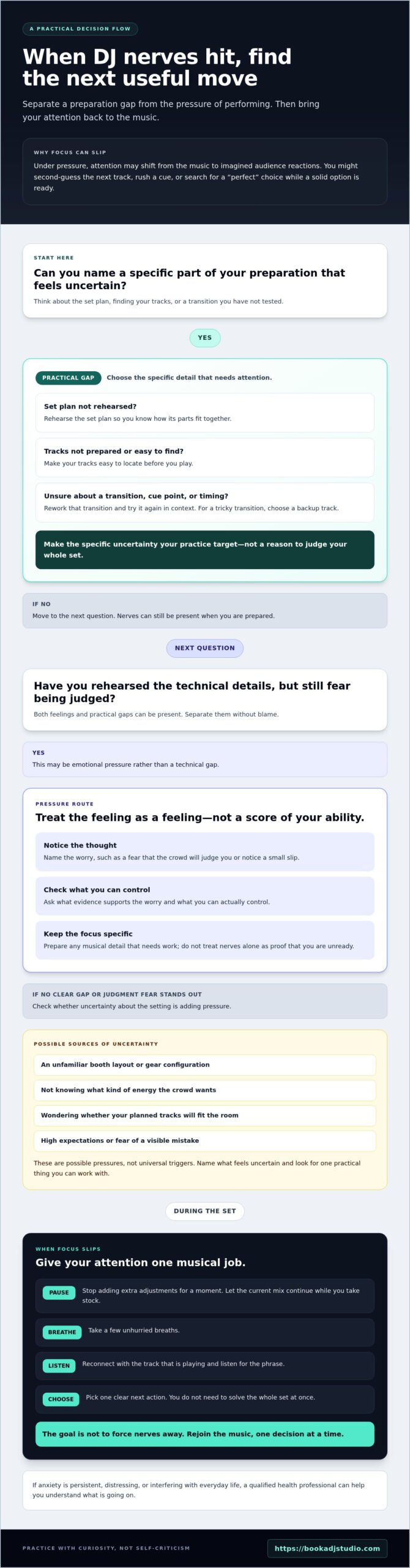
Get specific. If you haven’t tested a tricky transition, rehearse it and choose a backup track. If your main worry is that the crowd will judge you, more technical preparation may not answer that fear on its own. Notice what you’re telling yourself, then ask what evidence supports it and what you can actually control. Curiosity turns pressure into a clearer next step. Self-criticism just adds more noise to the mix.
How performance nerves affect focus, timing, and decision-making
During a set, your attention has a job: follow the music, read the room, and decide what comes next. Under pressure, some DJs find that their attention shifts toward imagined audience reactions instead. You might wonder whether someone noticed a tiny timing slip, even as the current track reaches the point where you planned to mix.
That split focus can make a familiar decision feel unexpectedly complicated. You may second-guess whether to bring in the next track, rush a cue because you’re worried about leaving a gap, or scroll through your library looking for a “perfect” choice while a solid option is already ready. These are possible responses, not automatic effects of nerves. They don’t mean you’ve failed or that your technique has disappeared.
Preparation and familiarity can leave you with more attention to spend on listening and responding to the music during a set. The aim isn’t to control every reaction in the room. It’s to give yourself reliable musical reference points so imagined judgment doesn’t take over the mix.
Why familiar transitions can feel harder under pressure
A transition you’ve practised may feel less automatic if you start checking every move while doing it. Instead of listening for the phrase change, you may mentally review whether your timing is right or imagine what the crowd thinks. That extra self-checking can make a straightforward choice feel like a high-stakes test, even when your hands know the routine.
Bring your attention back to one musical task. Listen for the phrase, check the track that’s playing, then decide whether to cue the next one. You don’t need to solve the whole set at once. One clear next action can help you rejoin the music without forcing a transition or assuming nerves will cause an error.
How to tell nerves apart from a preparation gap
Ask yourself a few practical questions: Have you rehearsed the set plan? Are the tracks prepared and easy to find? Have you tested the transitions you’re least sure about, including their cue points and timing? A specific “no” gives you a useful practice target. Rework that transition, then try it again in context instead of repeatedly running the entire set.
If you’ve rehearsed the technical details but still worry about being judged, the pressure may be more emotional than practical. Both can be present at once. You might know your tracks well and still feel exposed, or feel generally nervous while also noticing one weak handoff. Separate the two without blame: prepare the musical detail that needs work, and treat the feeling as a feeling, not a score of your ability. To build familiarity in a focused booth, explore DJ studio practice in Timișoara.
What to do when DJ nerves hit before or during a set
Give your attention a simple job. If nerves spike, don’t try to fix the whole set or force yourself to feel calm. Pause before making another move, reconnect with the track that’s playing, and choose one manageable next step. A short routine can reduce last-minute scrambling, even if some nerves stay with you.
- Pause. Stop adding extra adjustments for a moment. Let the current mix continue while you take stock.
- Breathe slowly. Take a few unhurried breaths and release tension in your shoulders and hands.
- Listen. Focus on the beat, phrase, and energy of the track that’s playing, rather than guessing what the audience thinks.
- Choose one action. Cue the next track, adjust one control, or hold steady and listen for another phrase.
A simple pre-set reset for DJs
If you can, arrive with enough time to settle into the venue instead of rushing straight into the booth. Take a few slow breaths, check your set plan, and review only the cues or transitions you want fresh in your mind. Keep the routine brief and adaptable: the setup, schedule, and space can change from one gig to another.
Think of this as a familiar starting sequence, not a promise that anxiety will disappear. A repeatable routine helps limit last-minute choices, so you can turn your attention toward playing.
How to recover after a mix does not go to plan
A rough transition can trigger the urge to make several corrections at once. Resist that spiral. First, listen to what’s actually playing. Is the current track still steady? Is there time to let it run? Choose one safe musical response, such as holding the mix, easing out of a level change, or waiting for a clearer phrase before cueing again. The right move depends on what you hear, so don’t rush into a fix just to escape the feeling of being watched.
Then return to the music. Self-criticism can pull your attention away from the next decision, while a practical reminder, “listen, then choose,” points you back to the task. Recovery is a performance skill, not a demand for perfection. Rehearsing what you’ll do after a transition slips can make that response feel more familiar when the pressure is real.
If anxiety is persistent, severe, or interfering with your ability to perform or manage everyday life, consider speaking with a qualified mental health professional. You don’t have to handle distress alone, and seeking support isn’t a judgment on your ability as a DJ.
To practise your set and reset routine in a focused booth, explore DJ studio practice in Timișoara. Build familiarity at your own pace, then bring that experience back to your next performance.
Build DJ confidence with repeatable practice, not pressure
Confidence gets stronger when practice gives you evidence of what you can do. Don’t make every session a high-pressure audition. Build a simple progression: work on individual transitions, play a complete set without stopping, then review the moments that felt uncertain. Each stage trains a different skill, from cue timing to staying present across a full mix.
Add realistic constraints gradually. Try a prepared track sequence or set a defined length for your practice run. These boundaries help you rehearse choices within a structure without turning the session into a test. To overcome dj performance anxiety, aim for repeatable experience, not a flawless run every time.
Turn a practice session into a confidence routine
Start with one clear goal, such as making transitions smoother or choosing tracks without endless second-guessing. Repeat the same section until you can focus on phrasing and energy, not just the mechanics. Then expand to a full-set run-through and keep the music moving if a transition isn’t perfect. At the end, name one thing that worked and one specific adjustment to practise next.
Familiarity with the booth matters too. Knowing where key controls are and how your usual workflow feels can reduce avoidable uncertainty when you play. If possible, practise on equipment that resembles what you expect to use. In Timișoara, Book A DJ Studio’s festival-style booth is ready to use with 2 Pioneer CDJ-3000X players, a Pioneer DJM-V10 mixer, 2 Yamaha DXR12 MKII speakers, and a Yamaha DXS15 MKII subwoofer. Bring your own headphones. Prepare your music in Rekordbox, scan the tracks, then export them to a USB stick no larger than 32 GB.
Use recordings to review progress constructively
A practice recording lets you revisit the set after the pressure of performing has passed. Listen for musical flow, phrasing, and how your choices connect, not only for imperfections. One awkward blend doesn’t define the whole mix. Look for patterns across sessions instead: perhaps a certain transition repeatedly feels rushed, or your track selection flows better when you leave more room to listen.
Keep your review focused. Note one moment you’d keep, one moment you’d change, and the next practice target. At the Timișoara studio, a wired recorder is provided. Your recorded mix is uploaded and emailed to the address supplied in the booking schedule a few days after recording, so you can review it with fresh ears rather than judging yourself mid-set.
Build your booth familiarity through focused DJ studio practice in Timișoara. Make each session a small, repeatable step toward a set that feels more like your own.
Use a Timișoara DJ studio to rehearse in a focused setting
A dedicated practice space gives you room to work on a set without the distractions of a live crowd. It isn’t a cure for anxiety, and you don’t need to wait for nerves to disappear before you rehearse. The value is practical: learn the booth workflow, settle into the controls, and give your attention more space for the music.
At Book A DJ Studio, at Str. Cipian Porumbescu no. 76, ap. 2, Timișoara, the ready-to-use festival-style booth has 2 Pioneer CDJ-3000X players, a Pioneer DJM-V10 mixer, 2 Yamaha DXR12 MKII speakers, and a Yamaha DXS15 MKII subwoofer. Rehearse a full set on this setup, or focus on a transition that feels less familiar. Repeating those actions in a focused setting can help you arrive at a performance with a clearer sense of your routine.
Make the rehearsal feel closer to a real performance
Give the session a performance-shaped goal: play a complete set without stopping, practise maintaining your flow between tracks, or get used to staying present behind the decks. The studio’s three Sony ZV-E10 cameras record in 4K from three angles, so you can review how your set came together. The recording is a way to notice details and track progress, not a guarantee of confidence or audience growth.
The three camera angles can help you review the performance as well as the audio. Notice whether you stay focused on the music and how your movements flow through the set. Use those observations to choose a practical goal for your next rehearsal.
The complete live-streaming setup is another option for practising your performance presence in a streamed format. Use it to get more comfortable playing through a set while being captured, and keep the goal within your control: practise the performance, not a promised response from viewers.
Plan your session so you can focus on the mix
Bring your own headphones and your music on a USB stick or HDD. For a USB stick, the maximum allowed size is 32 GB. Scan your music in Rekordbox before exporting it to the USB, then check that your planned tracks and cues are ready. Small prep steps can prevent avoidable distractions once you’re at the decks.
Book online through the website form by selecting an available day and time. Set a clear intention for your session before you arrive, such as rehearsing a complete set or getting comfortable with a particular transition. That way, your studio time has a focus, but you can still adapt if a track or idea takes the mix somewhere unexpected. A list of rules is available through the linked page.
A practical way to overcome dj performance anxiety is to make preparation familiar and repeatable. Explore the DJ studio in Timișoara and use a focused rehearsal session to build your own performance routine, one set at a time.
Let your next set be a step forward
You don’t need to feel completely fearless before you play. Give yourself a clear next step: choose one part of your set to practise, repeat it with intention, and notice what becomes easier. Confidence is built through those small moments of follow-through. Each time you return to the decks, you give yourself another chance to trust your decisions and stay connected to the music.
To overcome dj performance anxiety, focus on progress you can repeat, not a perfect performance you have to chase. Set a goal for your next rehearsal, whether that’s making one transition feel more natural or staying with your plan from start to finish. Then keep building, one mix at a time.
Book an online DJ studio session in Timișoara through the website form and make your next practice session count. Step into the booth with a plan, give your sound room to grow, and keep moving toward the set you want to play.
Frequently Asked Questions
Is DJ performance anxiety normal, even when you know your set?
Yes, you can know your tracks and still feel nervous about playing them in front of people. A familiar set doesn’t remove the unpredictability of performing, such as reacting to the room or being watched. Treat the nerves as a feeling, not a verdict on your ability. Before the gig, remind yourself of one thing you’ve prepared well, then give your attention to the music and the moment.
Can anxiety make it harder to beat-match or choose the next track?
It can make those tasks feel harder for some DJs, particularly if attention shifts toward imagined reactions or worries about mistakes. You might hesitate over a track choice or feel less sure of a beat-match you’ve practised before. That doesn’t mean anxiety will always disrupt your mixing. Use a familiar musical reference, such as phrasing or the incoming track’s energy, to guide the next decision.
How can I stop overthinking before a DJ performance?
You may not be able to switch off every anxious thought, but you can give your mind fewer decisions to juggle. Before the gig, write down essential set details, such as your opening track, a few reliable options, and any transitions you want to handle carefully. Once that’s done, stop revising the whole plan. A practical way to overcome dj performance anxiety is to focus on the next useful action, not every possible outcome.
What should I do if I make a noticeable mistake during a DJ set?
Don’t assume everyone has judged the whole set by one moment. Keep the overall musical direction in mind and avoid making a sudden change just to hide the slip. If the transition has disrupted the energy, use a track you know well to re-establish a steady flow. After the gig, note what happened while it’s fresh, then decide whether there’s a specific skill to practise or whether it was a one-off.
Does recording a practice mix help you become more confident as a DJ?
It can help you notice progress and identify patterns, but recording alone doesn’t guarantee confidence. Listen back when you’re not in the middle of mixing. Mark moments where the flow felt strong, then choose one point to work on, such as a transition that repeatedly sounds rushed. Compare that passage across later practice mixes. This turns playback into useful feedback rather than a search for every flaw.
Can practicing on club-standard equipment make a first performance feel more familiar?
Practising on a booth with a similar workflow can help you get used to navigating players and a mixer before a performance. That familiarity may reduce the number of unfamiliar actions you’re handling at once, though it can’t guarantee a particular gig will feel easy. In Timișoara, rehearse on Book A DJ Studio’s dedicated festival-style setup and give your set a realistic run-through.
When should a DJ consider professional support for performance anxiety?
Consider speaking with a qualified mental health professional if anxiety feels persistent, causes significant distress, leads you to avoid performances you want to do, or affects life beyond DJing. You don’t need to wait until you feel unable to perform to seek guidance. A professional can help you explore what’s happening and discuss appropriate support. Asking for help doesn’t mean you’re not committed or capable as a DJ.